Mal
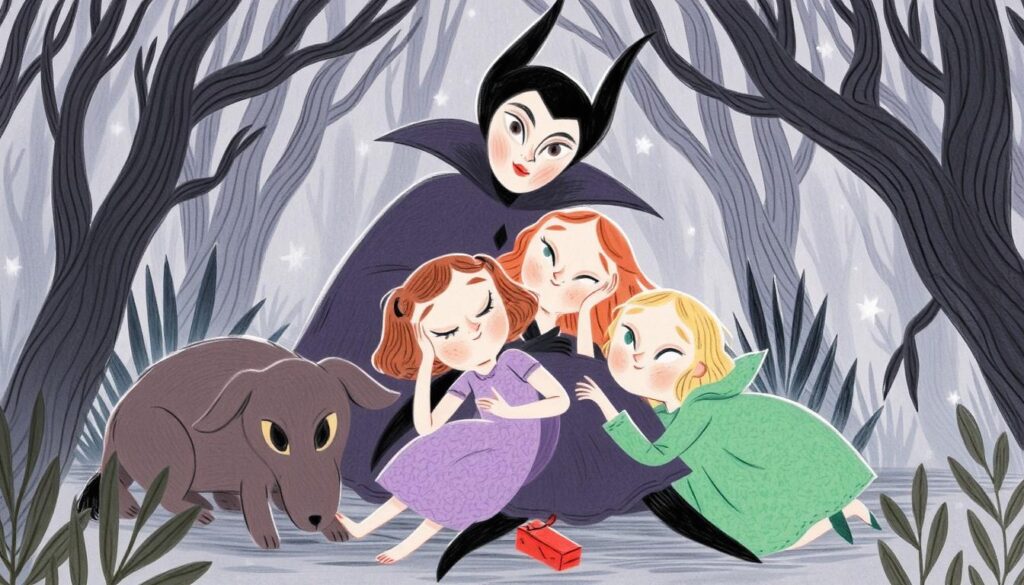
The Middle Sister — The Intentionalist — She Who Asks Why Before How
“She is the most dangerous of the three to argue with. The Beldam will consume you. Grimhild will outlast you. Mal will show you, patiently and without cruelty, exactly where your reasoning breaks down — and then ask if you would like to try again.”
At a Glance
| Status | Unknown (ancient) — present in the world as influence more than person; her bloodline is woven through the Highlands’ magical tradition |
| Alignment | True Neutral, though she would correct this: “Intent determines alignment, not category. I have been all of them at different moments. Currently I am trying to be useful.” |
| Domain | Gray Magick: moral intentionality in spellcraft, the ethics of power, the teaching and transmission of magical knowledge, the spaces between law and chaos |
| Symbols | A scale perfectly balanced; a flame that is neither warm nor cold; a road forking in three directions; a mirror showing something other than the viewer’s reflection |
| Divine Tier | Ancient demigod — middle daughter; less concentrated in a single bloodline than Grimhild, more distributed through individual practitioners and traditions |
| Titles | The Middle Sister, The Intentionalist, The Gray Teacher, She Who Weighs, The One Between |
| Known Kin | Mother: Lilith. Father: Samael. Sisters: Grimhild, the Beldam. Descendants: the Highlands’ sorcerer-kings; by bloodline and tradition, McGonagall. |
| Her central teaching | Technique is neutral. Intent is everything. The same spell can be the most benevolent or the most destructive act imaginable depending on what animates it. |
Part One — Origins and the Making of Gray Magick
The Middle Child and What That Means
Mal was born between Grimhild’s perfecting impulse and whoever the Beldam would eventually become, and she grew up in the gap between them in a way that shaped her completely. Grimhild catalogued and corrected. The Beldam, even young, consumed. Mal watched both of them and asked: why? Not accusatorially — genuinely. What is the purpose of the correcting? What is the purpose of the consuming? What do you want the world to be, and why do you want it, and is the why good enough to justify the what?
These questions annoyed both sisters enormously. Grimhild found them impractical. The Beldam found them irrelevant. Mal asked them anyway, because she had discovered early that the questions were the most important part of the work — that magic without examined intention was just force with better aesthetics, and force without examined intention was the One God’s mistake in miniature, endlessly repeatable.
Gray Magick is the system she built from this discovery. It is not the middle ground between White and Black in the sense of being a compromise or a dilution of both. It is a different project entirely: not ‘what does the magic do’ but ‘what is the magic for, and is that a good enough reason to do it.’ Every practitioner of Gray Magick is, first and foremost, a practitioner of that question. The technique comes after. The technique is almost secondary.
The hardest thing about Gray Magick is that it produces no comfortable answers. White Magick gives you the satisfaction of correction — things put right. Black Magick gives you the satisfaction of acquisition — needs met, hunger fed. Gray Magick gives you the question you started with, slightly better informed, and the obligation to answer it again. Most practitioners find this deeply frustrating. Mal considers it the only honest approach to power.
Part Two — The Highlands and Her Living Legacy
The Sorcerer-Kings and What Happened After
Mal’s most consequential decision was teaching. Not through a dynasty, as Grimhild taught through Lurline, but directly — person to person, over centuries, in the wild places and the mountain schools that eventually became the Highlands’ arcane academies. She taught mortals. Not fey, not witch bloodlines in the Grimhild sense, but people of Adam’s line who had discovered magic through proximity, accident, or ancestral pact, and who had no framework for what to do with what they had found.
The sorcerer-kings of the Highlands were her students in the oldest sense — not a continuous school but a tradition, each generation taught partly by the one before and partly, in the cases of the genuinely gifted, by something older than teaching. Their defiance of Aslan’s decrees against magic was her defiance expressed in mortal terms: the refusal to accept that a power you were born with or earned should be surrendered to an authority that did not create it and did not understand it.
McGonagall is Mal’s clearest contemporary expression. The mixed mortal-witch lineage — the One God’s mortal blood and Mal’s Gray Magick tradition woven together through centuries of Highland practice — produces exactly the tension Mal has always found most interesting: the question of what to do with power in a world full of competing claims on how power should be used. McGonagall navigates between Aslan and Jadis and the Beldam with the specific skill of someone trained to ask the right questions before acting, and who has the discipline to wait for the answers before she moves.
DM NOTE
If the party speaks with McGonagall about the deeper history of the Highlands’ magic, she will eventually acknowledge a source older than the sorcerer-kings. She does not name it. She calls it ‘the tradition before the tradition.’ If pressed: ‘Someone taught the first ones. The records agree on that much. They do not agree on who.’ She knows who. She simply has not decided if the party is ready to know.
Part Three — Personality, Character, and How to Play Her
Alignment: True Neutral — and What She Means By It
Mal would resist the label True Neutral if she thought it implied indifference, which it does not in her case. She cares about outcomes. She cares about people. What she does not do is allow her caring to override her examination — she will not act on the side of good simply because good feels right, and she will not act on the side of order simply because order seems stable. She acts when she has examined the situation and concluded that a specific act is warranted by a specific intention that she can defend on examination.
This makes her slow, by the standards of most active beings. And deliberate. And, in the moments when she does act, extremely effective, because there is nothing wasted — no surplus force, no collateral intention, no action that goes further than what the situation requires.
| Trait | Expression in Play |
|---|---|
| Questions everything, including herself | She does not exempt herself from examination. If the party challenges one of her positions, she will actually consider the challenge rather than defending the position reflexively. She may change her mind. She will say so if she does. |
| Genuinely curious about the party | She is interested in what people do with power when they have it, and the party has been doing interesting things. She will ask them about their choices — not accusatorially, but with the genuine intellectual interest of someone assembling a case study. |
| Extraordinarily patient | She will wait. She has been waiting for ten thousand years for mortal civilization to ask the right questions about magic. She will let a conversation develop at its own pace. She will sit with uncertainty. She will not rush toward a conclusion she has not earned. |
| Has a sense of humor that her sisters find exhausting | She finds the world genuinely funny in specific ways: the gap between what people intend and what they achieve; the consistency with which powerful beings make identical mistakes across different centuries. She does not make jokes. She observes things in a way that is very precise and occasionally devastating. |
| Quietly, privately protective of Lilith’s memory | She will not speak ill of her mother in any context. She will also, very gently, correct any mischaracterization — not by arguing, but by providing additional information that renders the mischaracterization unsustainable. This is her most Samael-like quality. |
Mal’s Role in the Campaign
Mal is the least directly present of the Three Sisters in the current political landscape, which means she is the most likely to appear as a genuine encounter rather than a legacy. She does not have a kingdom. She does not have a dynasty in the way Grimhild does. She has students, dispersed across the world, who carry her tradition in their practice without always knowing where it came from.
The party is most likely to encounter her influence in the Highlands arc — specifically through McGonagall, who carries the Gray Magick tradition in the most concentrated living form it takes. A sophisticated engagement with the question of intent versus technique in the context of the Devil’s Bargain arc — the question of whether a contract that was legally valid can be morally void — is exactly the kind of question Mal has been considering for millennia. She may surface.
Her relationship with the Ledger-Keeper is worth noting: they have met. They have had the argument about whether the intent behind a contract changes its binding force. Neither persuaded the other. Both remember the conversation with something that might be respect and might be the particular affection of two beings who have found someone else willing to genuinely engage with a difficult question.
If the party ever asks Mal directly what she believes — about magic, about good and evil, about the war between the One God’s line and Danu’s — she will be quiet for a moment and then say: ‘I believe that how you ask the question shapes what answers are available. You have been asking good questions. I am interested to see what you do with the answers.’
Leave a Reply