Mal’s Daughters — The House of Oz
Four Answers to the Same Question
“I taught them to defend an intention on demand. I did not teach them to agree with each other. I am not sure that was a mistake.”
Mal’s romance with Stephan was, characteristically, not impulsive. She examined it, decided it was worth the cost, and proceeded with full knowledge of what it would mean to love a king’s bastard son in a world arranged around legitimate succession. Stephan was Hammond’s son by a woman with no acknowledged claim to anything — except, as it turned out, a thin and unacknowledged thread back to Queen Lurline’s own collateral line, which is the reason his daughters’ eventual claim to Oz’s throne carried any legitimacy at all. Stephan was raised close enough to power to understand it and far enough from it to never fully trust it, which is exactly the kind of mind Mal found worth her time. He asked the same question she had spent millennia asking: what is this power for, and is the reason good enough?
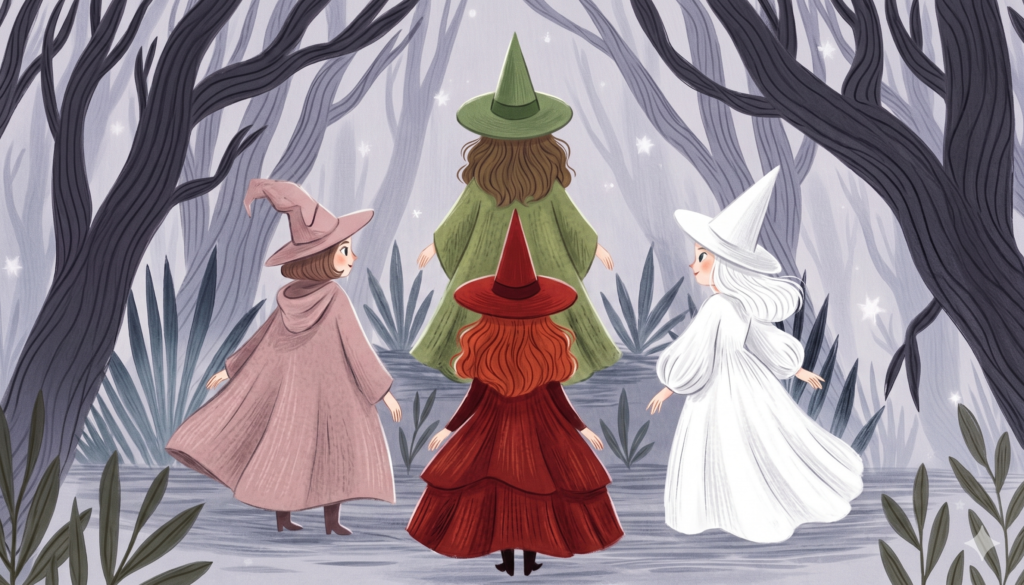
Their affair produced four daughters: Glinda, Elphaba, Nessarose, and Theadora. Mal did not marry him, did not stay, and did not hide the children — concealment was never her instinct; consequence was. She raised her daughters the way Lilith raised her: in the truth of what they were, with full information about what the world would do with that truth, and with the conviction that submission to an unjust arrangement was the one thing she would not require of them. Where Lilith’s lesson to Mal was “choice is sacred,” Mal’s lesson to her daughters was a refinement of it: “you will be judged by what you build with your power, not by how comfortable that power makes anyone else.” Four daughters, raised on the same premise, built four entirely different things — which is, in classic Three Sisters fashion, the most Mal-shaped outcome possible: she gave them an examined starting point and let them arrive wherever their own intentions took them.
Glinda — Witch of the North, Ruler of Oz
Glinda inherited Mal’s examined intention but pointed it toward consolidation rather than inquiry — she is the daughter who decided that asking the right questions forever, the way her mother does, leaves too much of the world ungoverned in the meantime. For centuries this made her the most outwardly beloved of the sisters: a charming, patient ruler who solved problems before anyone else fully understood what the problem was.
Something in her curdled. The examination that once produced careful, defensible rule started producing something colder: a conviction that goodness itself — uncomplicated, undefended, unexamined goodness — was a kind of weakness she could no longer tolerate near her throne. She began hunting “the pure”: Talking Animals who had never asked to be drawn into Oz’s politics, and the gentlest of the Gillikin nobility, anyone whose decency read to her as a naivety she could not forgive. Mal has never publicly commented on what her daughter became. Those who know Mal well suspect this is because she has not yet finished examining whether it was preventable.
It was during this period that Alice — a mortal traveler who had been slipping between her own world and Once since childhood — settled in Oz, married a Gillikin prince, and had a daughter. When Glinda’s purges reached the Gillikin court, Alice did not wait to find out whether her family would be spared for being beloved rather than merely good. She sent her daughter through a looking-glass, aiming for her own sister back in England and missing by a continent: the girl landed instead in Kansas, was raised by a farm couple named Henry and Em, and grew up as Dorothy Gale — utterly unaware that the tornado which eventually carried her back to Oz was returning her to the place her mother had once fled, or that the witch she would kill there was her own great-aunt.
This makes her the most outwardly beloved of the sisters and, underneath, the one who carries the most unexamined cost. Mal taught her daughters to defend their intentions on demand — Glinda can still do this beautifully, in public, on a moment’s notice, even now that the intention being defended is a purge. Whether she could have stopped Elphaba’s death — or stopped what she herself became before it cost her sister’s life and scattered the rest of her family across three kingdoms — is the load-bearing wound of her character. Her claim to the Emerald Throne, inherited from Stephan’s distant, unacknowledged tie to Lurline’s line, is also, in a sense, the place where her father’s legitimacy and her mother’s philosophy were forced to coexist — and where, lately, neither has held.
Nessarose — Witch of the East, Champion of the Munchkins
Nessarose took her mother’s principle — power justified by who it serves — and built her identity entirely around the Munchkins, the smallest and most politically overlooked people in Oz. Mal has always cared about who gets protected and why, and Nessarose translated that into literal patronage of the most vulnerable population in her territory. It is sincere. It is also, potentially, a closed loop: championing the powerless can calcify into needing them to stay powerless so the championing still matters, and that tension is one a party should be left to discover rather than be told outright.
Theadora — Witch of the South, Champion of the Proper Animals
Theadora’s cause cuts most directly against Oz’s social order: the Animals — those with the capacity for speech, reason, and personhood — versus the unthinking animals beneath them. Championing “Proper Animals” specifically means she has drawn the line at sapience, not species, which is a very Mal distinction: protection proportional to capacity for choice, almost verbatim her mother’s metric for who deserves moral consideration. She did not just advocate for Talking Animals — she personally taught a great many of them the speech, reasoning, and self-governance that made them Proper Animals in the first place. That work is hers in a very literal sense, which is exactly why she was not willing to watch it become a hunting list.
When Glinda’s purges of “the pure” began in earnest, Theadora did not stay to argue the point with her sister. She led every Proper Animal who would follow her out of Oz entirely. Most stopped with her in Sithean, where Mother Goose’s realm already let Talking Animals, fey, and mortals coexist without anyone needing to ask permission — a soft landing Theadora had not engineered but was grateful to find. A smaller group continued north with Jadis, who was passing through on her way to claim Narnia and saw no reason to leave useful, loyal allies behind. Theadora has never fully forgiven herself for the ones who didn’t make it out, and she has never fully forgiven Glinda for making the choice necessary in the first place. She is the ideological purist of the four, the sister most likely to recognize her great-great-grandmother Lilith’s defiance in herself, and probably the one Mal is quietest and proudest around — in the specific way Mal expresses approval: by asking harder questions, not easier ones.
Elphaba — Witch of the West, Exiled to Gillikin Country
Elphaba inherited the most dangerous part of Mal’s nature: the refusal to stop examining even after everyone around her has decided the conversation is over. She did not get a kingdom or a constituency — she got cast as a villain by people who needed a simple story more than an accurate one, which is exactly the failure mode Mal has spent ten thousand years naming. Power without examined intention “is just force with better aesthetics,” and Elphaba’s tragedy is that she may have been the sister practicing the most genuinely examined magic, and it did not save her from being narratively flattened into a monster anyway. Her flight to Gillikin Country, before Dorothy Gale killed her, reads as someone trying to buy time to finish an argument she never got to complete — and neither of them ever knew that Dorothy was family: Glinda’s own niece, sent away from Oz as a child to escape the very purges that would, years later, bring Dorothy back to kill her aunt.
Elphaba’s union with Fiyero Tigelarr, a prince of the Vinkus carrying Lurline and Grimhild’s own thinned bloodline, produced Jadis — the White Witch of Narnia. Jadis carries the full technical inheritance of White Magick from her father’s side and Mal’s examined-intention inheritance from her mother’s, and has inverted both into something neither parent would recognize as their own: where White Magick restores, she freezes; where Gray Magick questions before acting, she has stopped questioning entirely and simply acts. She is the one place in the family where Grimhild’s discipline and Mal’s inquiry both failed to prevent the same catastrophe.
DM NOTE
All four daughters took a different piece of the same inheritance — examined power, deserved protection, accountable intention — and built a kingdom, a cause, a doctrine, and a death out of it, respectively. That is a deliberate, one-generation-down echo of the Three Sisters themselves (order, hunger, inquiry). What makes the House of Oz different from its predecessors is that the corruption arrived after the fact: Glinda did not start as Jadis started, inheriting a cold inheritance and inverting it. She started warm, examined, and beloved, and went dark on her own, which is the scenario Mal’s entire philosophy was supposed to prevent and did not. Officially, Oz’s history remembers Elphaba as the wicked one and Glinda as its rightful, gracious queen; anyone who actually talks to Mal about either daughter would tell a very different story about both of them. Dorothy Gale — raised in Kansas, unaware she is Glinda’s niece and Alice’s daughter, unaware that the witch she killed was her own great-aunt — is a live thread the party can pull at any point: if she ever learns the truth, the question of what she does with it, and whether Glinda survives the answer, is entirely the table’s to write.
Leave a Reply