Jareth, the Goblin King (Peter Pan)
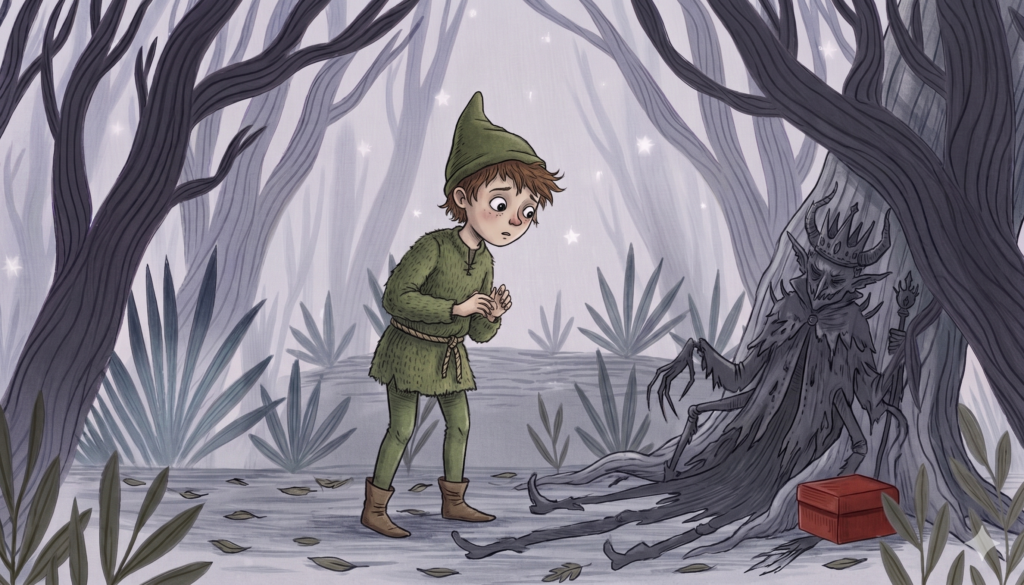
The Boy Who Wouldn’t Grow Up — The Goblin King — He Who Chose a New Hunger
“Glinda lost her son twice: once when he ran, and once when he stopped being the boy who ran and became something that does not, anymore, want to come home.”
At a Glance
| Status | Living; rules the Impassible Desert and the Labyrinth |
| Alignment | Chaotic Neutral, with flashes of something crueler when he is bored and something almost wistful when Oz comes up uninvited |
| Domain | The Impassible Desert, the Labyrinth, wished-away children, bargains struck at thirteen hours, the specific magic of growing old without growing up |
| Symbols | A barn owl in flight; a crystal ball that shows you what you fear rather than what is true; a clock face with thirteen hours; a single peacock feather |
| Divine Tier | Mortal-fey scion — grandson of Mal, great-grandson of Lilith and Samael; the only member of his generation who traded his inheritance for something else entirely rather than claiming or fleeing it |
| Titles | Peter (birth name), Peter Pan (self-made), Jareth, the Goblin King (chosen), the Boy Who Wouldn’t Grow Up, the Owl King |
| Known Kin | Mother: Glinda. Grandmother: Mal. Aunts: Elphaba, Nessarose, Theadora. No father has ever been named, by Glinda or anyone else. |
| His contradiction | He left one throne so he would never have to become his mother. He built a second one so he would never have to answer to anyone again — hers included. |
Part One — Peter, and the Boy Who Refused to Be an Heir
What It Was Like to Be Glinda’s Son
Peter was born into a court that had not yet curdled. Glinda’s early reign was, by every account, the warm one — patient, clever, beloved — and Peter grew up the only son of a queen the whole of Oz seemed to adore. This should have been enviable. It was, instead, the specific kind of suffocating that only the children of extraordinary parents understand: every room he entered already had an opinion of who he was going to become, and none of those opinions had asked him.
He was not like his aunts. Nessarose found a cause and built herself around it. Theadora found a principle and gave her whole life to it. Elphaba kept examining things long after everyone wanted her to stop. Peter examined nothing. He simply knew, with the flat certainty children sometimes have about themselves before adults talk them out of it, that he did not want the Emerald Throne, did not want a region to govern, did not want to be the answer to the question of what Glinda’s son would do with his inheritance. He wanted to not be anyone’s heir at all.
The Running
So he ran — not in anger, not even really in rebellion, but in the manner of someone quietly let himself out a door he was fairly sure no one would chase him through. He went where Oz’s authority got thin and the old wild magic got thick: toward the Impassible Desert, toward the lawless edges the maps call the Neverlands, where the borders between what is real and what is merely believed have never been particularly well enforced.
There he became someone new. Peter Pan was not a disguise — Peter genuinely stopped aging, by some combination of will, fey inheritance, and the particular permissiveness of the place he’d run to, and he has never fully explained which of the three did the most work. He gathered other lost children around him — the abandoned, the runaway, the simply uncounted — and built something that was not quite a kingdom and not quite a family: the Lost Ones, ageless and ungoverned, answering to a boy who had appointed himself their captain and their proof that growing up was optional.
DM NOTE
Peter Pan’s refusal to age is one of the few pieces of magic in Once that nobody, including Peter, can fully account for. He will not explain it because he does not entirely understand it himself, and being asked irritates him in a way that suggests the irritation is covering something closer to fear. If the party wants a mechanical or metaphysical explanation, the DM should feel free to invent one — or, better, to leave it permanently unresolved. Some magic in Once is not meant to be audited.
The Trouble With Forever
Eternity, it turns out, is a worse trade than it looks. The Lost Ones stayed children, but the world around the Neverlands did not stop moving, and Peter discovered — slowly, and with the specific resentment of someone realizing a plan has a flaw he should have seen coming — that being permanently twelve gets lonelier with every decade. Children he gathered eventually wanted things he couldn’t give them: growth, change, an ending. Some left. He took it personally every time, and pretended not to.
It was in this period that he made the acquaintance of a sea captain with a grudge and a hook for a hand, and the two of them have been locked in a feud of magnificent, theatrical pointlessness ever since — full of duels, insults, and an entirely genuine mutual loathing that has somehow never once resulted in either of them actually leaving the other alone. Captain Hook is one of the only people in Once who has crossed Peter and survived it more than once, a fact Peter finds far more flattering than he will admit and far more important to his self-image than its surface silliness suggests.
Part Two — The Labyrinth, and the Making of the Goblin King
Tired of the Same Thirteen Years
Eventually — no one agrees on exactly when, and Peter is not telling — the boy who wouldn’t grow up got bored of not growing up. Not regretful. Not ready to go home. Bored, in the specific existential way that comes from having solved the only problem you set out to solve and discovering the solution doesn’t fill the hours.
At the edge of the Impassible Desert, in territory even the Lost Ones avoided, there was a Labyrinth that predated anyone’s memory of who built it, inhabited by goblins who served no one because no one had ever successfully claimed them. Peter walked in as the boy who refused to grow up. He walked out — far longer than anyone watching could account for — as Jareth, an adult in every visible respect, owner of a bargain he has never fully disclosed the terms of, and sovereign of the goblins and the Labyrinth both.
What Was Traded
What Jareth gained is plain enough to see: an adult body that does not age the way a mortal’s does, absolute rule over the Labyrinth and its goblins, and a very specific power — the ability to claim children who are wished away by the people meant to love them, and to give those wishers exactly thirteen hours to come and take it back. What he gave up for it is the part he will not discuss. Something was owed. Something was paid. The Lost Ones who knew him as Peter say he came back colder, more elegant, more dangerous, and unmistakably sadder in a way he has spent the centuries since covering very well.
He extended the Impassible Desert as one of his first acts as Goblin King — not out of malice, by his own account, but because a king who controls more sand controls more leverage, and leverage was the entire point of becoming someone who could no longer be talked out of anything. The trade routes that died when the Desert grew were collateral, and he has never apologized for them.
DM NOTE
The exact nature of the bargain — what the Labyrinth and its goblins actually took from Peter to make him Jareth — is deliberately left open. A DM can use this as a hook in almost any direction: a debt still owed, a piece of him left behind that something else now holds, a rule he is bound by that he has never told anyone. Whatever the answer is, Jareth himself does not bring it up, and a party that finds a way to ask the right question rather than the obvious one may get further than they expect.
Part Three — Personality, Character, and How to Play Him
Alignment: Chaotic Neutral
Jareth answers to no code and serves no cause, which is exactly the point — he spent his whole childhood as the answer to someone else’s plan and built two entire identities specifically to avoid that ever happening again. He is not cruel for its own sake, though he can be cruel when it amuses him, and he is not kind for its own sake either, though he is sometimes kind in ways that surprise even him. He does what interests him, governed by rules of his own invention that he enforces with theatrical, occasionally maddening precision — thirteen hours, not twelve, not fourteen, because the number is his and the number is final.
| Trait | Expression in Play |
|---|---|
| Performs everything | Jareth rarely says a thing plainly when he can say it with a flourish. Conversations with him feel staged, because to him they are. This is not insincerity — it is armor, worn so long it has become indistinguishable from his actual personality. |
| Genuinely, specifically bored | He has solved his own problems twice now and is not eager to do it a third time. A party that offers him something genuinely novel — a real puzzle, a real risk, a real surprise — will get more of his attention than one offering wealth or threats. |
| Rules-bound by his own design | His bargains are precise, oddly fair, and absolutely inflexible. He will not bend the thirteen-hour rule for anyone, including himself, because the rule being unbendable is the entire source of his authority. Test the letter of one of his deals at your own risk — and at your own potential advantage. |
| Allergic to being managed | Any attempt to flatter, manipulate, or out-maneuver him in an obvious way will be noticed immediately and will cost the attempter standing. He has spent his whole existence avoiding being anyone’s instrument. He notices instrumentalizing immediately, in anyone. |
| Unresolved about Glinda | He does not speak about his mother unprompted, and he changes the subject, elegantly, if someone else brings her up. If the party has dealt with Glinda’s purges, his reaction to learning what she’s become is one of the few moments his composure genuinely cracks — not into grief, exactly, but into something close to it. |
Jareth in the Campaign
Jareth does not typically interfere in mortal affairs, and the party is more likely to come to him than the reverse. The most natural hook is a wished-away child: someone in the party’s orbit, in a moment of fury or despair, says the wrong words about a child they love, and the Labyrinth answers. From there the party is in Jareth’s territory, on his clock, playing by his rules — and the thirteen hours are real, and so is the consequence of running them out.
He is also one of the few living beings who can speak to what Glinda was like before she went dark, and a party that earns enough of his attention to ask him directly may get an answer more honest than they expect — delivered, of course, with considerable style, and likely at a cost he will name only once they have already agreed to pay it. He has no loyalty to Oz, no stake in the Beldam’s expansion, and no interest in Dagon’s ambitions; he is one of the rare figures in Once who can be approached without the weight of the larger war pressing on the conversation. This makes him useful. It does not make him safe.
Captain Hook remains, by a wide margin, the person most likely to give the party honest information about Jareth’s habits, weaknesses, and history — freely, at length, and entirely for his own amusement. Whether any of it is reliable is a separate question, and Hook would be the first to admit he doesn’t especially care.
Leave a Reply