Dorothy Gale
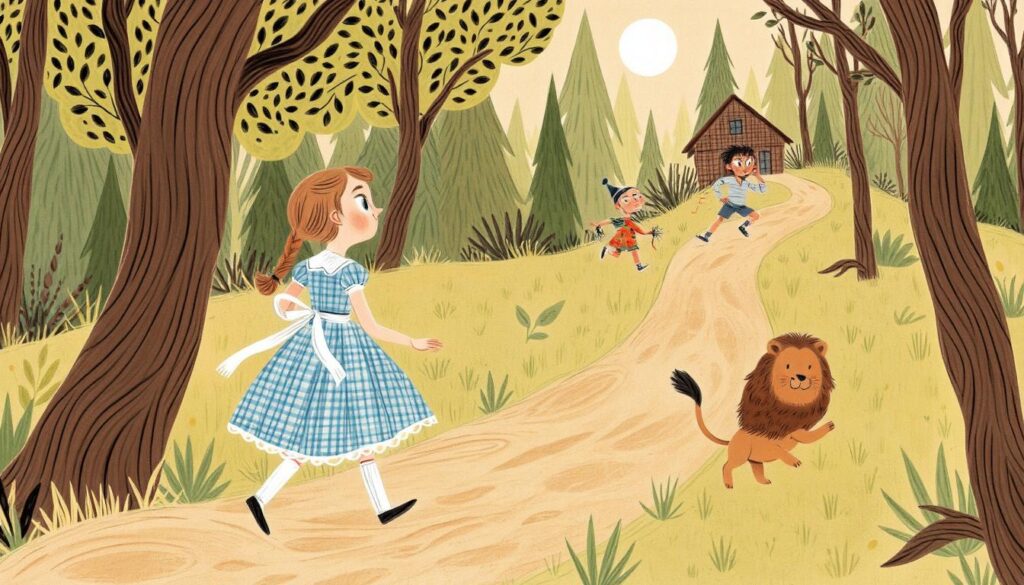
The Girl Who Fell Twice — Kansas’s Daughter, Oz’s Heir — She Who Doesn’t Know Her Own Name
“Nobody told her the tornado was taking her home. Nobody could have. She doesn’t know it herself yet, and when she finds out, the question won’t be whether to believe it — it will be what to do with two great-aunts, one she killed without knowing and one she killed knowing exactly what she was doing.”
At a Glance
| Status | Living; resides on a farm in Kansas, in the world outside Once, with occasional and unwilled trips into Oz |
| Alignment | Neutral Good — plainspoken, brave, fiercely loyal to the family that raised her, and increasingly unsettled by what keeps happening to her |
| Domain | None. Fully mortal, with no awareness of any connection to Once whatsoever — her trips there register, to her, as something between a dream and a trauma she cannot explain to anyone who wasn’t there |
| Symbols | A pair of enchanted shoes she did not ask for and has not been able to remove; a farmhouse that flew once and only once; a small dog who has been to Oz twice and shows no sign of caring |
| Divine Tier | None known to her. Half outer-world stock through a mother she has never met; half Gillikin nobility through a father whose name she does not know. Raised in complete ignorance of both. |
| Titles | Dorothy Gale (the only name she has ever been given); unwitting slayer of two witches; the only mortal in living memory to enter Oz and leave it again on her own terms |
| Known Kin | Adoptive parents: Henry and Em, Kansas farmers, the only family she has ever known. Biological mother: Alice, alive and searching for her in Oz, neither aware the other exists to be found. Biological grandmother: Mal. Great-aunts: Glinda, Elphaba (slain by Dorothy directly), Nessarose (killed by Dorothy’s house, neither of them aware of the relation), Theadora. |
| Her contradiction | She has killed two of her own great-aunts and not once known she was family to either of them. |
Part One — Kansas, and the Storm That Wasn’t Just Weather
A Farm, an Ordinary Life, and a Sky That Went Wrong
Dorothy grew up exactly the way her aunt and uncle raised her to: plainly, honestly, on a farm that gave them all more work than comfort and more weather than either. She never knew her parents — only that she had been brought to Henry and Em as an infant, with no explanation anyone ever gave her that held up to a direct question, and that the household’s unspoken rule was not to ask twice. She grew up curious anyway, restless in the specific way of a smart child in a small place, and devoted to a small dog who seemed to sense, before she did, that the weather that particular afternoon was not behaving like weather.
The tornado that lifted the farmhouse off its foundation and set it down somewhere that was emphatically not Kansas remains, to Dorothy, the single most disorienting event of her life — and she has had two of them now. The first time, the house came down on top of someone. Dorothy did not understand, in the moment, that the woman crushed beneath her aunt and uncle’s home was the reigning Witch of the East, beloved champion of an entire nation of small, overlooked people called Munchkins. She understood only that she had killed someone, by accident, by falling out of the sky, and that the people gathering around the wreckage seemed — bewilderingly — grateful to her for it.
The Shoes, and Walking a Road She Didn’t Choose
The dead witch’s shoes came to her almost immediately, claimed onto her feet by magic she never consented to and has not since been able to undo. They mark her, instantly and visibly, as someone of significance in a world she does not understand and did not ask to matter in. She has worn them every day since, partly because she cannot remove them and partly — though she would not put it this way herself — because taking them off has started to feel like erasing the only proof she has that any of this actually happened to her.
What followed was a long, strange road toward a city made of green glass, in the company of companions she trusts more completely than she has ever trusted anyone in Kansas, in search of a wizard she was told could send her home. None of them — not Dorothy, not her companions, not the wizard himself when she finally reached him — fully understood that the simplest route home ran directly through the one remaining sister of the witch she had already killed.
DM NOTE
Dorothy’s house landing on and killing Nessarose, the Witch of the East and champion of the Munchkins, is a direct, deliberate echo of the classical Oz story — repurposed here so that the “good witch sends Dorothy on her way with stolen shoes” beat is also, unbeknownst to everyone present, a story about a girl unknowingly killing her own great-aunt. Nobody at the scene, including Dorothy, has any reason to suspect a family connection, and nothing in the text should tip Dorothy off until the party — or fate — decides she’s ready to know.
Part Two — The Witch of the West, and the Family She Never Knew She Had
What She Was Sent to Do
Word of the East’s death traveled fast, and so did word of the shoes now standing on a stranger’s feet in the middle of a road heading toward the Emerald City. Elphaba — the Witch of the West, exiled to Gillikin Country, already carrying more grief and isolation than anyone around her fully understood — had every reason to take a personal interest in the girl who had killed her sister and inherited her sister’s power without lifting a finger to earn either. She has pursued Dorothy’s party for most of their journey: flying monkeys, poisoned fields, a hundred small cruelties and a handful of large ones, none of which Dorothy has ever had the context to read as anything other than a monster’s malice.
It is not malice, not entirely, and not simply. Elphaba is, in this telling, fighting for the only thing she has left that resembles family standing — a claim against the world that killed her sister and crowned a stranger for it — and she does not know, any more than Dorothy does, that the stranger wearing her sister’s shoes is her own great-niece. Glinda’s missing daughter, sent through a looking-glass years ago by a mother desperate to save her from exactly the kind of danger Oz has become, has arrived back in Oz anyway, in the one form nobody could have predicted: an enemy, on a road, wearing the wrong family’s shoes.
The Confrontation
What happens at the end of that road is, depending entirely on how a table chooses to run it, either a tragedy or an execution, and the campaign deliberately does not resolve which. Dorothy kills Elphaba — by water, by fire, by whatever method a DM chooses to stage it — fully believing she is ending the threat of a wicked witch who has hunted her across half a country. She has no idea she has now killed both of her great-aunts, the second time with full intent and a clear conscience, and she returns from Oz to Kansas with a story nobody back home will ever fully believe and a debt to her own bloodline that she does not know exists.
DM NOTE
This is the campaign’s most loaded dramatic irony, and it should be treated with care rather than triumph. Dorothy’s actions are not villainous — she had no information that would have let her choose differently, and Elphaba’s pursuit of her was genuinely dangerous regardless of motive. The horror here is structural, not moral: a family was torn apart by Glinda’s purges, and the pieces of it collided without ever recognizing each other. If the party is present for the confrontation, they are watching something far sadder than a fight between a girl and a witch, whether they understand that yet or not.
Part Three — Personality, Character, and How to Play Her
Alignment: Neutral Good
Dorothy is plainspoken, loyal, and braver than she has any reason to expect of herself — qualities her aunt and uncle instilled without ever intending to prepare her for flying monkeys or talking lions. She wants, more than anything else stated or unstated, to go home, and the longer Oz keeps pulling her back the more that wanting has started to curdle into something closer to dread.
| Trait | Expression in Play |
|---|---|
| Homesick in a way that never fully resolves | Even mid-adventure, even surrounded by genuine wonder, some part of Dorothy is doing math about Kansas: the chores undone, the aunt and uncle worrying, the life that is actually hers waiting on the other side of whatever this is. |
| Trusts faster than is strictly wise | She bonded with a scarecrow, a tin man, and a lion inside of a single afternoon’s walking, and would do it again. Her instinct toward found family is immediate and largely uncomplicated by suspicion. |
| Carries guilt she cannot fully name | She has killed two people now, in a world where everyone keeps insisting both deaths were good and necessary. She has not entirely metabolized this, and a perceptive party member who asks how she’s actually doing — rather than congratulating her — may get the most honest answer she has given anyone since arriving. |
| Does not know what she does not know | She is unaware of her parentage, her grandmother, her great-aunts, or the fact that Oz has any claim on her beyond geography. Any information the party shares with her about her own bloodline should be treated as a genuine, possibly destabilizing revelation, not a fact she’s been quietly sitting on. |
| Wants, fiercely, to be ordinary again | Unlike most people who discover a hidden destiny, Dorothy is not hoping for one. If offered power, a throne, or a place in Oz’s politics, her honest first instinct is to decline it in favor of the farm. Whether the party or the narrative lets her keep that instinct is an open question. |
Dorothy in the Campaign
Dorothy is reachable, narratively, on both sides of the boundary between worlds — in Kansas, where she is simply a farm girl with an inexplicable story and an unremovable pair of shoes, and in Oz, where she periodically reappears whenever the tornado (or whatever mechanism a DM prefers) decides to pull her back. A party that meets her in Oz is meeting someone fundamentally out of her depth, doing her best, surrounded by a political and magical landscape she has no context for and very little patience to learn.
The campaign’s live thread, as noted in Mal’s Daughters’ entry, is entirely the table’s to decide: does Dorothy ever learn that Alice is her mother, that Glinda is her aunt, that the witch she killed in cold blood and the witch her house crushed by accident were both blood relatives? If she learns the truth, what she does with it — confront Glinda, seek out Alice, retreat permanently to Kansas and refuse the whole inheritance — is not predetermined by anything in her character so far, and that is deliberate. She has spent her entire life being handed circumstances she didn’t choose. The one thing the campaign owes her, narratively, is an ending where she finally gets to choose something herself.
Leave a Reply