Snow White
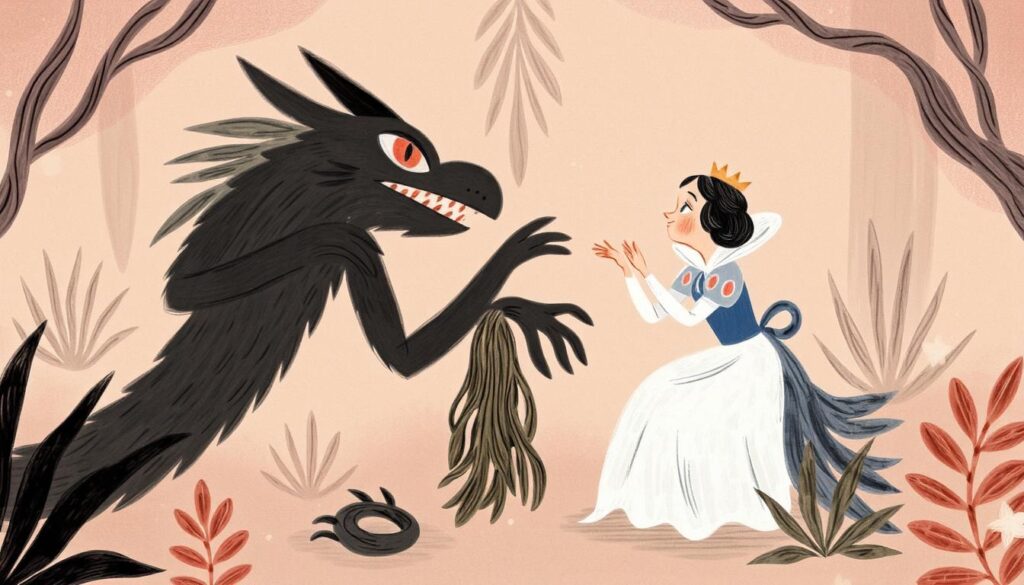
The Queen Who Counted the Cost in Someone Else’s Coin — The Ambitious One — She Who Did Not Survive the Bargain She Tried to Keep
“She spent her whole reign believing the debt was hers to manage. She died finding out it was never going to be settled by anyone but the person she planned to pay it with.”
At a Glance
| Status | Deceased — killed by her own daughter, Sable, who struck first when Snow White moved to offer her to Dagon |
| Alignment | Lawful Evil in practice, though she would have called it Lawful Neutral — duty to the crown, applied without sufficient limit |
| Domain | None divine. Fully mortal, of the Germonian royal branch descending through Astor and Hilde |
| Symbols | A mirror she consulted more than any advisor; an apple, untouched; a crown that outlasted her |
| Divine Tier | Mortal — descended from the One God through Adam and Eve’s mortal line, by way of the bloodline that struck the original bargain with Dagon five centuries ago |
| Titles | Queen Consort of Germonia, the real power behind King Henry’s nominal rule, the woman who tried to re-unify Grimm and instead unmade her own family |
| Known Kin | Husband: King Henry, largely absent, easily frightened, still nominally on the throne. Daughter: Sable, who killed her. |
| Her contradiction | She told herself she was protecting her kingdom by knowing exactly what the ancient debt required. Knowing it did not make her capable of refusing it when the moment came. |
Part One — The Real Power Behind a Frivolous Throne
A Marriage of Convenience That Became a Career
Snow White married King Henry in the manner most political marriages in Grimm are made — for the alliance, not the affection — and discovered quickly that Henry’s appetite for governing extended exactly as far as the appetite for everything else he indulged: enthusiastically, briefly, and without follow-through. She did not complain. She filled the vacuum instead, methodically, until everyone in Germonia’s court understood without anyone saying so that decisions ran through her and Henry’s signature was a formality attached afterward.
She was good at it. This is the part of her story that gets flattened by what she eventually did — for most of her reign, Snow White was a genuinely capable administrator who held a fractious, ambitious kingdom together while her husband gambled and philandered his way through the years. Her ambition was real, and for a long time it expressed itself in competent, unremarkable governance rather than anything dangerous.
Knowing About the Debt
What made Snow White dangerous was not her ambition. It was what she knew. The Germonian bloodline’s five-century-old bargain with Dagon — a daughter of the line, promised in exchange for dominion over Grimm — had been buried under generations of strategic amnesia by the time she married into the family. She found it anyway, in old records most of her predecessors had never bothered to read closely, and she understood immediately what most of her predecessors had managed not to: the debt was real, it was unpaid, and it was eventually going to come due regardless of whether anyone wanted it to.
DM NOTE
Snow White’s discovery of the Dagon bargain predates her decision to use it. A DM running flashback material or earlier-era scenes involving her has room to portray her, for years, as someone who held this knowledge carefully and did not act on it — which makes her eventual choice land as a decision made under acute pressure (the wider Grimm conflict, her own ambition to reunify the kingdom) rather than something she was always going to do.
Part Two — The Choice, and What It Cost
Wanting Grimm Whole Again
Snow White’s ambition sharpened, in her later years, into something larger than competent administration: a genuine desire to re-unify all of Grimm under her rule, ending the five-hundred-year fracture that had split the kingdom into the Hinterlands, Corona, Enchancia, Germonia, and the Enchanted Forest. This was not pure self-interest by her own accounting — she believed, with the particular conviction of someone who has decided their cause justifies the cost, that a unified Grimm would be stronger, safer, and better governed under her than scattered across five quarreling thrones.
She knew exactly what dominion over Grimm would cost, because she had read the old bargain closely enough to know its price. A daughter of the bloodline, delivered to Dagon. She had a daughter. Sable was thirteen years old.
The Final Act
Snow White did not frame what she was about to do, even to herself, as sacrifice in the cruelest sense — she told herself it was statecraft, the kind of hard, necessary decision rulers throughout history have made and been remembered for rather than condemned over. She approached Dagon’s collection with the intention of negotiating, of offering Sable in exchange for the dominion the original bargain promised, treating her own daughter as the final instrument in a transaction she had been managing, in her own mind, for years.
Sable did not wait to be delivered. She killed her mother first — a decision the histories record without much ambiguity about where the blame belongs — and then offered Dagon her mother’s body as a substitute payment. Dagon accepted it as a down payment. The original contract, notably, remains open. Snow White’s death did not settle the debt. It only proved, decisively, that she had never actually been the one in control of it.
DM NOTE
Snow White’s death is intended to land as a moral indictment with real weight, not a simple villain’s comeuppance. She was, for most of her life, a competent and not unsympathetic ruler whose ambition curdled into something monstrous only at the very end — and the person who paid for that final choice was a child who had spent her whole life being raised, consciously or not, as a contingency. A table that wants to explore Sable’s grief, rage, or guilt has full license to do so; nothing about Snow White’s death requires Sable to feel uncomplicated relief, and nothing requires her to feel uncomplicated guilt either.
Part Three — Personality, Character, and How to Play Her (In Flashback or Memory)
Alignment: Lawful Evil in Practice
Snow White is best understood as someone who believed devoutly in duty and order and used both as the vocabulary for a decision that was, underneath the framing, an act of profound cruelty toward the one person who had no say in any of it. She did not consider herself evil. Few people who end up there do.
| Trait | Expression in Play |
|---|---|
| Composed under any visible pressure | Snow White rarely showed strain publicly. Whatever calculation was happening underneath, the surface stayed smooth — a quality that made her an effective ruler and, in hindsight, an unsettling parent. |
| Genuinely believed she was the competent one | Her contempt for Henry’s frivolity was real, and so was her conviction that the kingdom needed her specifically to hold it together. This conviction is what eventually let her justify the unjustifiable. |
| Treated family as an extension of statecraft | Sable was, to Snow White, simultaneously a beloved daughter and a strategic asset — and she never fully reconciled the two, which is precisely how she arrived at a decision that required pretending the second description could override the first. |
| Read the old records nobody else would | Her diligence was genuine. She did the work her predecessors avoided. The tragedy is that the work led her somewhere none of them had been brave or foolish enough to go. |
| Did not see the blow coming | For all her political acumen, Snow White appears to have fundamentally misjudged her own daughter — treating Sable as compliant material for a plan rather than a person capable of ending it. |
Snow White in the Campaign
Snow White is dead before the party’s central involvement with Sable and Dagon begins, which makes her presence in the campaign retrospective rather than active: a name in old records, a motive the party has to reconstruct, a parent Sable has killed and has not finished processing. A DM running flashback scenes, dream sequences, or archival discovery can use Snow White directly; otherwise she exists primarily as the explanation behind the danger Sable is still in.
The most important use of her in play is restraint: Snow White should never be flattened into simple villainy for the sake of an easy emotional beat. She is the campaign’s clearest demonstration of how an ordinary, competent person can talk themselves into something monstrous one justified step at a time — and Sable, and the party, are left living in the wreckage of that particular kind of failure.
Leave a Reply