Captain Hook
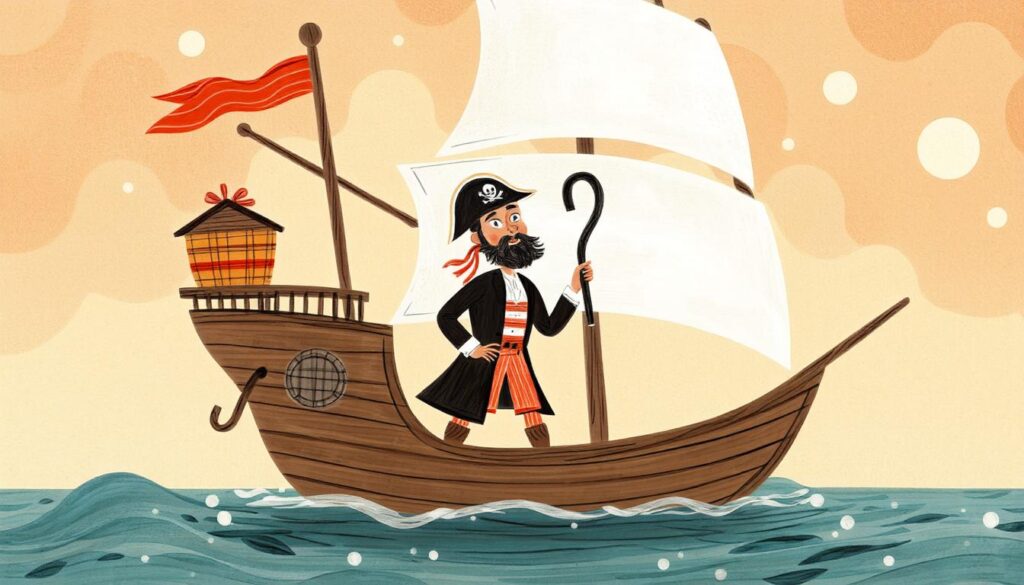
The Captain Who Inherited Someone Else’s Debt — Ruler of Neverland — He Who Has Not Left His Ship in Six Months
“He is not repentant, exactly. He is exhausted. Ask him whether he’d make the same choice again and watch him not answer that either.”
At a Glance
| Status | Living; rules Neverland from the Jolly Roger, currently anchored in Pegport’s outer harbor |
| Alignment | Neutral, sliding toward Neutral Evil in practice — a man who made one terrible accommodation decades ago and has been managing the consequences ever since |
| Domain | None divine. Fully mortal, of an old seafaring family, ruling a realm soaked in fey and lost magic that his bloodline has no actual claim to |
| Symbols | A hook where a hand used to be; a pocket watch that doesn’t run; a ship that has not sailed in months |
| Divine Tier | Mortal — squarely of the One God’s mortal line by blood, ruling a domain whose true power belongs to Peter Pan’s old magic, the merfolk’s bargain, and forces considerably older than his family’s claim to the captaincy |
| Titles | Captain Hook, ruler of Neverland, longest-seated member of the Pirate Council |
| Known Kin | No named family beyond an inherited captaincy and crew; his most significant relationships are professional and adversarial rather than blood — Smee, the Lost Boys he has “rescued,” and Jareth, his oldest rival |
| His contradiction | He told himself, for decades, that what he was doing was mercy. He has not been able to tell himself that in the last several months, and the inability has cost him most of his composure. |
Part One — A Captaincy, and a Debt That Wasn’t His
Inheriting the Ship, Inheriting the Bargain
Captain Hook did not strike the bargain that defines his entire rule. The original deal — safe passage and favorable winds across the Cerulean Sea, in exchange for one child delivered to the merfolk of Mermaid Lagoon each year — was made generations ago by his predecessor as captain of the Jolly Roger, and Hook inherited it the way captains inherit ships: along with everything good and everything terrible the position already carried. By the time he understood what the contract actually required, he was already its keeper, already bound by terms he had never agreed to, in a position where refusing meant losing every ship under his command to the merfolk’s retaliation.
He has met the debt for decades through the Lost Boys — children he “rescues” from the mainland and eventually delivers to the deep. He has told himself, with the specific, practiced conviction of someone protecting his own ability to keep functioning, that this is a kind of mercy: children who would otherwise have nothing, given purpose and belonging for however long they have left, rather than simply vanishing into an indifferent sea with no story attached. He has held onto this framing for a very long time. It has been getting harder.
The Rivalry That Outlasted Everything
His feud with Peter Pan — and later with Jareth, the Goblin King Peter became — is the longest-running relationship of his adult life, outlasting crews, ships, and most of his own certainty about who he is outside of it. It began as genuine enmity and has calcified, over the centuries, into something stranger: a rivalry so familiar it has become load-bearing, one of the few constants Hook can rely on in a life otherwise defined by an arrangement he despises and cannot escape.
DM NOTE
Hook’s history with Jareth predates the Goblin King’s transformation and has continued through it. Jareth is one of the only beings who has crossed Hook and survived it more than once, and the inverse is equally true — Hook is one of the few people Jareth treats as a genuine, ongoing rival rather than a curiosity. Their dynamic should read as old, exhausting, and almost affectionate in its familiarity, even when the stakes of a given encounter are genuinely dangerous.
Part Two — The Debt Comes Due Again
Three Children Per Year
The Ledger-Keeper acquired Hook’s original contract and, on taking possession of it, tripled the demand — three children per year instead of one, citing the expanded scope of the Jolly Roger’s current operations as justification. Hook refused to simply triple the supply of Lost Boys to match. This refusal did not stop the merfolk from collecting; it simply changed their method. They have begun wrecking ships directly, specifically targeting vessels with children aboard, taking what they were promised without waiting for Hook to deliver it through his usual arrangement.
Hook has known about this escalation for months. He has not responded to the harbormistress’s repeated requests for help, has not addressed the Pirate Council, and has not left the Jolly Roger — moored conspicuously in the outer harbor — in all that time. The sealed contract notice from the Ledger-Keeper has been sitting in his cabin since it arrived, unopened, because opening it means confronting a problem he has spent decades avoiding by other means and has finally run out of room to keep avoiding.
What Finally Forces His Hand
Hook will open the Ledger-Keeper’s contract in the presence of whoever finally corners him into doing it — not because he has found new resolve, but because avoidance has stopped being a viable strategy and the universe, in the specific person of a party that has tracked the situation to his door, has run out of patience with his stalling. What follows is not a villain’s defiant confession. It is closer to relief, mixed with shame, mixed with the specific exhaustion of someone who has been holding a single terrible secret for so long that simply saying it out loud feels like collapsing.
DM NOTE
Hook’s confession scene should land as morally complicated rather than triumphant. He is not repentant in any clean sense — pressed on whether he would make the same choice again, faced with the same impossible alternative of losing every ship under his command, he genuinely does not have an easy answer, and a good table will let that discomfort sit rather than resolving it for him. His ending is explicitly left to the players: redemption, consequence, an uneasy negotiated peace with the merfolk, or something else entirely. There is no clean answer built into his character, and there shouldn’t be one supplied for him.
Part Three — Personality, Character, and How to Play Him
Alignment: Neutral, Sliding Toward Neutral Evil in Practice
Hook is not cruel by temperament. He is a man who made one terrible accommodation under genuine duress decades ago and has spent every year since managing the fallout of that single choice, telling himself smaller and smaller versions of the justification as the cost has become harder to ignore. He is tired in a way that has started to look, from the outside, like indifference.
| Trait | Expression in Play |
|---|---|
| Performs theatrical menace, badly hides genuine exhaustion | Hook still has the old pirate-captain swagger when he needs it, but it slips more than it used to, especially when the conversation turns toward the merfolk, the Lost Boys, or anything he’s been avoiding. |
| Genuinely afraid of one specific thing | Tick Tock the crocodile, whose ticking heart Hook can hear coming from a considerable distance, represents a fear he will not perform around but cannot fully hide either. The sound of that ticking, even distant, costs him visible composure. |
| Loyal to his crew in a way that complicates everything else | Whatever else is true about Hook, Smee and the rest of his crew trust him, and that trust is not misplaced — he protects his own people fiercely, which sits uncomfortably alongside what he’s done to other people’s children. |
| Avoids rather than confronts | His default response to an unbearable problem is to not look at it, sometimes literally — months spent aboard a ship that hasn’t sailed, a contract left sealed on a desk. A party that wants information from him will get further by giving him room to approach the topic than by demanding he face it immediately. |
| Capable of real honesty once cornered | Once the avoidance finally breaks, Hook does not lie about what he’s done or try to minimize it. The confession, when it comes, is unflinching — it is simply very, very late. |
Captain Hook in the Campaign
Hook is the emotional and narrative center of Neverland’s arc — not a simple villain to defeat, but a man whose decades-long avoidance the party’s arrival is finally forcing to a head. The merfolk crisis, the missing students from the Constance of Belleville, and the Ledger-Keeper’s tripled demand all converge on him, and a party investigating any one of these threads will eventually have to deal with Hook directly, whether they intend to or not.
His seat on the Pirate Council — held for over forty years, unusually long — and his consistent voting against any motion that would benefit Dagon’s interests are both worth noting as evidence that Hook is not simply a man who has given up on everything. He has a code, even now, even exhausted, even compromised by his own worst choice. What the party does with that complexity — punish him, redeem him, simply leave him to live with it — is entirely theirs to decide, and the campaign is deliberately built not to hand them an easy answer either way.
Leave a Reply