Elsa
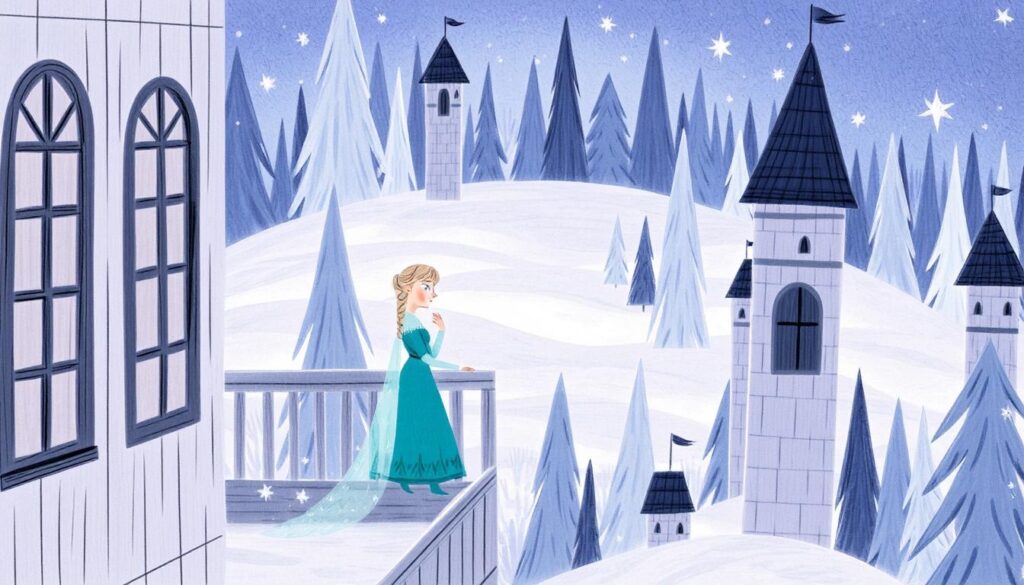
The Queen Who Learned to Stop Hiding — Arendelle’s Frozen Heart, Fully Thawed — She Who Watches the Horizon Carefully
“She spent her childhood being told her gift was a danger to manage. She rules now on the opposite premise — that what she is, properly understood, was never the problem. The fear around it was.”
At a Glance
| Status | Living; rules Arendelle, beloved and largely unchallenged on her throne |
| Alignment | Lawful Good — careful, principled, and increasingly willing to act decisively when the careful approach runs out of time |
| Domain | None divine in rank, though her ice magic descends from a Feywild infusion deep in House Arendelle’s bloodline — an echo of Danu’s elemental daughters surfacing generations later |
| Symbols | A snowflake with six perfect points; a fjord frozen solid in a single night; a closed glove, now worn open |
| Divine Tier | Mortal by lineage, fey-touched by inheritance — her ice magic traces to an old infusion in Balzar’s line rather than to any direct descent from Danu herself |
| Titles | Queen Elsa of Arendelle, the Snow Queen (old usage, no longer needed as a warning) |
| Known Kin | Parents: King Agnarr and Queen Iduna, lost at sea. Siblings: King Eric of Tirulia, Princess Anna (Arendelle’s ambassador), and a youngest brother lost as an infant and now ruling Greystoke under a different name, unaware of his true lineage. |
| Her contradiction | She spent years believing her power needed to be hidden to keep the people she loved safe. She now rules a kingdom that is safest precisely because she stopped hiding it. |
Part One — A Childhood Spent Concealing
A Gift Arriving Before Anyone Knew What to Do With It
Elsa’s ice magic surfaced in early childhood, vivid and uncontrolled, the kind of power that delights a child before anyone around her fully understands its danger. The accident that changed everything — magic reaching further than she intended, touching someone she loved without meaning to cause harm — taught her, far too young, that her gift could hurt the people closest to her if she was not perfectly careful. Her parents responded the way frightened parents with a kingdom to protect often do: concealment. Gloves. A closed door. A girl raised to believe that the safest version of herself was the most hidden one.
This worked, in the narrow sense that nothing else went wrong for years. It also cost Elsa most of her childhood relationship with her own sister, with her own household, and with any sense that her power was something other than a problem to be managed. She does not discuss this period with anyone who hasn’t earned the right to ask, and even then, carefully.
What Broke the Concealment
Her parents’ deaths at sea, en route to Rapunzel and Eugene’s wedding, forced a succession Elsa was not emotionally prepared for and a coronation that put her, gloved and controlled, directly into the kind of public scrutiny her whole childhood had been organized around avoiding. What happened next — the concealment finally failing, the magic surfacing fully and publicly, a winter that arrived somewhere it had no business arriving — is the part of her story most of Arendelle remembers vividly and most of Once now treats as ancient history rather than scandal.
She does not regret how it ended, even though she regrets, deeply, how long it took and what the delay cost her relationship with Anna in the meantime. What she found, on the other side of being fully seen, was not the catastrophe she had spent her whole childhood fearing. It was a kingdom that loved her anyway, and a sister who had never stopped wanting her back.
DM NOTE
The exact mechanics of Elsa’s powers — what she can and can’t do, how far the magic extends, whether it has limits she hasn’t found yet — are left flexible for a DM to calibrate to the needs of a given scene. The emotional core that should remain constant is the contrast between the hidden, frightened version of her power and the open, controlled, genuinely joyful version she has built since: the same magic, transformed not by growing weaker but by no longer being treated as shameful.
Part Two — A Beloved Queen Watching a Widening War
Ruling Well, and Knowing It Isn’t Enough
Elsa rules Arendelle with a combination of competence and genuine warmth that has made her one of the more secure and well-regarded monarchs in Once — her people trust her, her sister serves as her most effective ambassador, and her decisions, when she makes them, tend to be both careful and correct. This security has given her something most rulers in the current political landscape lack: the ability to watch the wider world’s unraveling from a position of relative safety, rather than being pulled into crisis by her own kingdom’s instability.
She has not mistaken this safety for permanence. Elsa has been watching the Grimm conflict’s slow escalation, the disturbing rumors out of Oz and Wonderland, and the general sense that Once is approaching something worse than its current fractures, with the specific vigilance of someone who knows from personal experience how quickly a contained problem can stop being contained.
The Family She’s Still Piecing Together
Elsa’s relationship with her siblings is a quiet, ongoing thread in her life rather than a resolved one. Eric rules Tirulia, entangled in Tirulia’s old sea-deity bargains in ways that occasionally worry her. Anna serves as her ambassador, carrying the dynastic weight Elsa’s magic exempted her from in ways neither of them has fully processed. And somewhere in Greystoke, ruling a kingdom of his own, is a brother neither of them has properly found — lost as an infant, raised entirely outside Arendelle’s knowledge, currently unaware of the lineage that would explain why Greystoke’s wild creatures accepted him as their lord in the first place.
DM NOTE
Whether Elsa has any current knowledge of her lost brother’s survival and location in Greystoke is left to a DM’s discretion — she may suspect, may know nothing, or may have heard old rumors she has not yet had reason to investigate seriously. A reunion arc between Elsa and her brother, handled with care, has real emotional weight: an entire family that lost each other to the same shipwreck, scattered across three different thrones, each unaware of how close the others actually are.
Part Three — Personality, Character, and How to Play Her
Alignment: Lawful Good
Elsa governs with the specific care of someone who once believed her own existence was dangerous and has spent years rebuilding her relationship with her own power into something controlled, intentional, and genuinely good. She does not act rashly, and when she does act decisively, it is because she has already done the careful thinking other rulers skip.
| Trait | Expression in Play |
|---|---|
| Composed by long practice, not by nature | Elsa’s calm is a skill she built, not a default setting. Under genuine pressure, the old instinct toward concealment can briefly resurface — a flicker of the girl who once believed showing too much of herself was dangerous. |
| Protective to a fault, working on it | Her instinct is to handle danger alone rather than risk anyone else getting hurt by it — a direct legacy of the childhood accident that shaped her. She is actively, visibly trying to unlearn this, with mixed success. |
| Genuinely warm once trust is established | Beneath the controlled exterior, Elsa is affectionate, a little wry, and deeply loyal to the people who have earned her trust — Anna most of all. |
| Takes responsibility seriously, sometimes too much of it | She has a tendency to treat problems in her vicinity as hers to solve, a habit that serves Arendelle well and occasionally exhausts her personally. |
| Watches for patterns others miss | Having lived through one slow-building crisis that nobody addressed early enough, Elsa is unusually attentive to early warning signs in the wider political landscape — and unusually willing to act on them before they’re undeniable. |
Elsa in the Campaign
Elsa is one of the more stable, trustworthy rulers a party can approach for alliance-building or information — she has genuine resources, a secure throne, and real concern about the wider conflict rather than narrow self-interest. A party bringing credible evidence of danger from Oz, Wonderland, or the Beldam’s expansion will find her a receptive, capable ally rather than a skeptic who needs convincing.
The richer thread, if a table wants it, is her unresolved family — the possibility of reuniting with a brother neither she nor Anna has ever properly known, and the question of what that reunion would mean for three kingdoms that have spent years assuming their royal houses were exactly as small as they appeared. Elsa would want to know. Whether the party is the one to tell her is entirely up to them.
Leave a Reply