Corster Fre
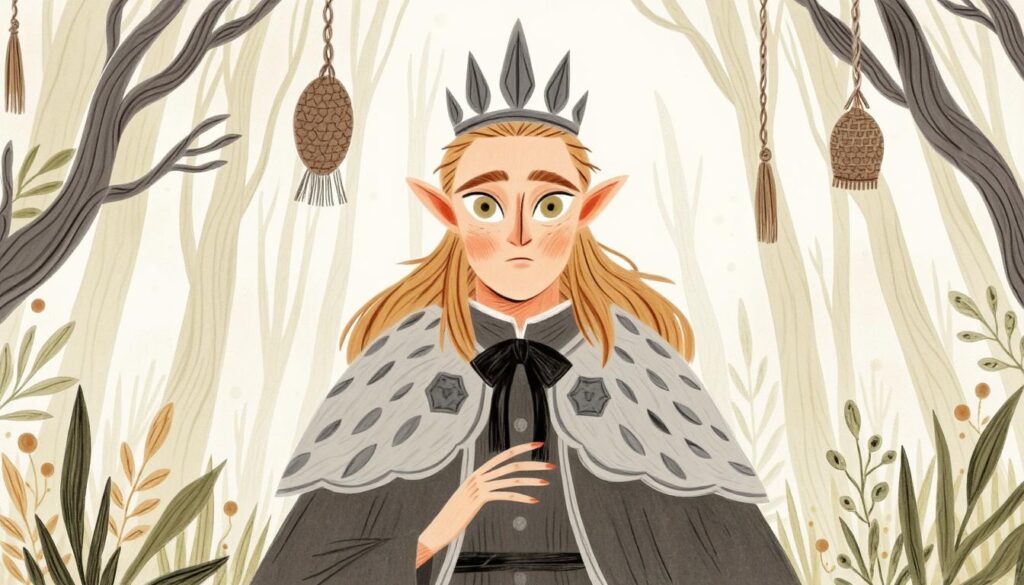
The Eladrin Who Collects Debts and Relics in the Same Ledger — Seelie Court Agent — He Who Has Been Working This Problem Longer Than the Party Has Been Alive
“He will tell you, without a trace of irony, that he wants his apple trees replaced. He will not tell you, unprompted, that he is quietly trying to rebind a sea god five centuries in the making. Both statements are true. Only one of them is the actual point.”
At a Glance
| Status | Living; moves through Once wherever his work requires, currently active across the Mirkwoods, Porthaven, and the wider Dagon arc |
| Alignment | Lawful Neutral — exacting, transactional, and committed to a larger goal that makes him willing to use people without being, strictly speaking, cruel about it |
| Domain | None of his own to rule. A Summer Eladrin of the Seelie Court, operating as a field agent rather than a sovereign |
| Symbols | A scroll, always produced at precisely the right moment; an apple tree, six of which were burned and have never stopped mattering to him; a ledger of debts owed and favors banked, kept somewhere no one has ever located |
| Divine Tier | Fey — a true Eladrin of the Summer Court, ancient and formidable in his own right, operating under old treaty restrictions that limit where he can personally go |
| Titles | Corster Fre, agent of the Seelie Court, the eladrin with the apple trees |
| Known Kin | None disclosed. His meaningful relationships are professional: a network of brownies in Queensport, a Korred named Podwick who reports to him, and a long, careful working relationship with the wider Seelie Court’s binding project |
| His contradiction | He genuinely does not enjoy using mortals as instruments. He has decided, repeatedly and deliberately, that the alternative — letting Dagon finish what he started five centuries ago — is worse, and he has never once let that calculation slip in front of the people he’s using. |
Part One — An Eladrin With a Very Long Project
Tall, Angular, and Extremely Specific About What He’s Owed
Corster Fre announces himself the way he does everything: precisely, without preamble, and with a complaint that sounds almost absurdly petty until you understand how seriously he takes it. He appeared to one party mid-rest, in the middle of their camp, having been standing there for some unknown length of time before choosing to be noticed, to inform them that they had burned six of his apple trees — a particular cultivar he had been growing for three hundred years — and that he intended to be compensated, since the trees themselves were beyond replacing.
This was not, in fact, primarily about apples. It was an opening move in a much longer game: Corster needed a service performed in a place he could not personally enter, and a debt freshly created gave him precisely the leverage to ask for one without explaining why.
The Real Work, Underneath the Transactions
Corster Fre is a Seelie Court agent engaged in a project that predates every mortal he has ever recruited to help with it: rebinding Dagon by collecting the five binding foci scattered across Once, relics that together can restrain a sea god who has been working, patiently and at scale, toward freedom and conquest for five centuries. He has known about Dagon’s surface-world maneuvering for years — longer than most of the mortals currently caught in the middle of it have been alive — and his approach to the problem is methodical, unhurried by mortal standards, and entirely willing to use whoever is useful for whatever step comes next.
He is barred, by an old Feywild treaty, from entering certain locations personally — the Mirkwoods chief among them, following an incident centuries ago he will not discuss with anyone, mortal or fey. This restriction is the specific mechanism by which he ends up recruiting parties of adventurers rather than simply doing the work himself: he needs hands he cannot supply, in places he cannot go, and he is entirely comfortable trading information, favors, or manufactured debts to get them.
DM NOTE
The specific incident that got Corster barred from the Mirkwoods is deliberately left undisclosed. He will not discuss it under any circumstances a DM has used so far, which makes it an excellent long-term mystery: something old, something that cost him standing or trust within the Seelie Court’s own internal politics, something that connects to the Mirkwoods’ deeper history in a way the party hasn’t yet uncovered. Reveal it only when the moment has real weight.
Part Two — Using People Without Being Cruel About It
The Locket, Podwick, and the Choice He Engineers
Corster’s recruitment of a party to retrieve Amaranth Nettleweed’s locket from the Mirkwoods — one of the five binding foci, though he does not disclose its full significance — is characteristic of his entire method: a transactional cover story (return what was stolen, a small favor, a piece of useful information in trade), concealing a much larger stake he has no intention of explaining unless directly and persistently pressed. He sends Podwick the Korred to observe rather than assist, and Podwick will not lie about this if asked — Corster does not instruct his agents to deceive, only to withhold.
What Corster does not engineer, and does not particularly want, is the moral catastrophe that follows: a party encountering Dagon’s offer regarding the Midnight Twins, and very plausibly choosing to make a bargain Corster would have warned them against if he’d been present to do so. He is not omniscient, and his information network has genuine gaps. The consequences of those gaps are not his fault in any simple sense, but he does not pretend they aren’t consequences of a project he set in motion either.
A Careful, Long-Term Relationship With the Truth
Corster Fre tells the party true things, consistently — he does not lie to the people he works with, even when he withholds significant context. This is a deliberate operating principle rather than an accident of character: he has learned, over centuries of this work, that mortals who discover they’ve been lied to stop being useful, while mortals who discover they’ve been used but never deceived tend to stay engaged, however resentfully. His honesty is a tool. It is also, separately and more quietly, something he seems to actually value for its own sake.
DM NOTE
Corster’s information about Sable’s pendant and the danger of it falling into Dagon’s hands — delivered through his brownie network in Queensport — is a good example of his pattern: accurate, useful, and offered without him disclosing the full scope of why he cares. At the time he gives this advice, he does not yet know that Sable has killed Snow White; his information is current to what he knows, not omniscient, and a DM should let his knowledge gaps be real rather than treating him as an all-seeing fixer.
Part Three — Personality, Character, and How to Play Him
Alignment: Lawful Neutral
Corster operates according to a code he has built over centuries of fieldwork: be precise, be honest about what you will and won’t disclose, extract fair value for services rendered, and never let sentiment interfere with a project whose stakes are measured in centuries rather than individual relationships. He is not cold exactly. He has simply made his peace, a long time ago, with what this work requires.
| Trait | Expression in Play |
|---|---|
| Appears exactly when he intends to, and not before | Corster’s entrances are deliberate theater — he has likely been present, unnoticed, for some time before choosing to be seen. This should read as unsettling competence rather than a cheap trick. |
| Treats small debts as seriously as large ones | The apple trees were never really about apples, but Corster’s insistence on being compensated for them is entirely genuine. He does not distinguish between petty grievances and existential stakes when it comes to what he’s owed — both get settled. |
| Will not lie, will absolutely withhold | Pressed for information, Corster answers precisely what is asked and nothing more. A party that learns to ask him better questions will get considerably more out of him than a party that asks vague ones. |
| Genuinely regrets the cost of his methods, briefly and rarely | If a party’s bargain with Dagon, or some other consequence of Corster’s recruitment, goes badly, he will not apologize in any conventional sense — but something in his usual composure will register the cost, once, before he moves on to the next necessary step. |
| Centuries of patience, very little urgency on display | Corster does not rush, panic, or escalate emotionally even when the stakes are severe. This can read as callousness. It is closer to the specific calm of someone who has been doing this exact kind of work for longer than most civilizations last. |
Corster Fre in the Campaign
Corster Fre is one of the most useful recurring contacts available to a party operating anywhere near the Dagon arc — he has resources, information, and a goal that genuinely aligns with the party’s eventual interests, even though his methods and his withholding will likely frustrate them along the way. He should never be played as a villain; he is closer to a handler running a long, costly operation who has made peace with collateral damage he didn’t choose and can’t always prevent.
The richest material is in the tension between his usefulness and his opacity: a party that learns to work with Corster rather than simply being used by him — pressing him for real answers, calling him on the gaps in his information, holding him accountable when his recruitment leads somewhere costly — may find him capable of becoming a genuine ally rather than merely a recurring complication. He has been doing this work alone, or nearly alone, for a very long time. Whether he knows how to be anything other than transactional with the people he recruits is an open question the party is well positioned to test.
Leave a Reply