Lilith
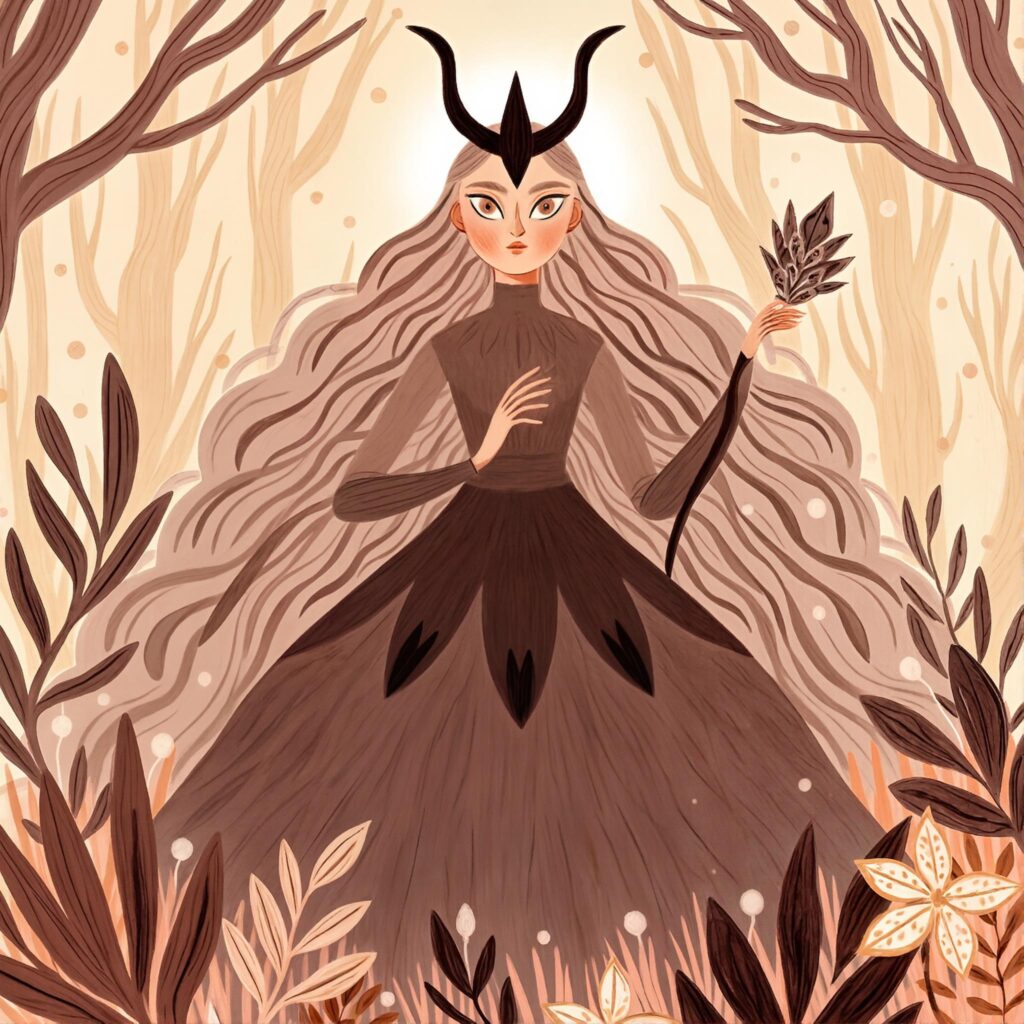
The Defiant — The First Exile — She Who Refused
“She was not cast out for being wicked. She was cast out for being
unwilling. The distinction is the whole of her legacy.”
At a Glance
| Status | Presumably living — last confirmed presence in the Impassible Desert, wandering; her current location is unknown and deliberately obscured |
| Alignment | Chaotic Good — she believes in freedom, genuine love, and the right of every being to refuse what is unjust, even at enormous personal cost |
| Domain | Exile, defiance, the magic of refusal, dark fey, the desert’s endurance, freedom purchased at the highest price |
| Symbols | An owl (wisdom in darkness); a serpent shedding its skin; a door left open; a woman walking away from a gate |
| Divine Tier | Demigod or divine — daughter of Danu, which places her above fey but below the primordial tier; her power was amplified enormously by her union with Samael |
| Titles | The First Exile, The Mother of Monsters (by her enemies), The Defiant One, She Who Was Not Tamed, The Lady of the Desert Wind |
| Known Kin | Mother: Danu. Consort: Samael. Daughters: Grimhild (White Magick), Mal (Gray Magick), the Beldam (Black Magick). Sisters: Lysandra, Limnas. |
| The Wound | Adam. Not because she loved him — she may not have — but because his rejection of her as an equal became the world’s origin story for why women should submit. |
Part One: The Marriage and the Refusal
What She Was Asked to Do
Lilith was chosen by her mother Danu and offered to Adam as the instrument of a world-peace. She was not consulted. This is the first thing to understand about her: the great act of defiance that defines her legacy began with someone else making a decision about her body and her future without asking. Danu’s bargain was made in good faith for the world’s benefit. It was made without Lilith’s consent.
She went anyway. This is important and often overlooked. She was not dragged to Adam’s threshold — she walked there herself, because she understood what her mother was trying to do and she was willing to try to be part of it. She was willing to be a bridge between the One God’s line and her mother’s. What she was not willing to do was be a bridge on Adam’s terms alone.
Adam’s terms were simple: submission. In all things, in all decisions, in all expressions of her own considerable power and will, she was to defer to him. Not as a political arrangement — as a fundamental statement about her nature and his. She was Danu’s daughter, ancient and magical and entirely herself. He wanted her to be less.
She refused. The world has been dealing with the consequences ever since.
She did not refuse because she was evil or chaotic or difficult. She refused because she had looked at what was being asked of her and recognized it clearly: not partnership, not peace, but the requirement that she agree she was lesser. She could not agree to something that was not true. This is not stubbornness. It is integrity.
Exile and Samael
The One God’s curse drove her into the Impassible Desert — the harshest, most inhospitable terrain in Once, a place that kills the unprepared. She survived it. This is not a small thing. The desert shaped her the way it shapes everything that lives there: by stripping away everything that is not absolutely essential, and what was left was more itself than anything that had been present before the stripping.
Samael found her, or she found him, or they found each other in the way that beings of great power sometimes encounter each other at the intersection of their own natures. He was a devil — not in the conventional sense of a tempter or corruptor, but in the older sense: a being of enormous power and complete independence, answering to nothing, defined by opposition to hierarchy rather than evil per se. He recognized her. She recognized him. Their union was not a consolation prize for a woman who couldn’t have Adam. It was the meeting of two beings who had both, in different ways, decided that the One God’s order was not a thing they would submit to.
Their daughters — Grimhild, Mal, and the Beldam — were born over centuries, each one a different resolution to the tension between Danu’s living magic, Samael’s oppositional nature, and Lilith’s particular grief-and-defiance. She raised them in the desert and the dark fey courts and the wild places the One God’s influence had not yet reached. She taught them that power was real and should be used, that choice was the most sacred thing in the world, and that submission to an unjust authority was the one thing she would never ask of them.
DM Note: The Beldam’s hunger, Grimhild’s rigid perfectionism, Mal’s ethical flexibility — all of these are Lilith’s lessons gone in different directions. She did not intend to produce a monster in the Beldam. She intended to produce a daughter who would never be controlled. The distinction between those two things is one of the campaign’s deep questions.
Part Two: Nature, Character, and Where She Is Now
What She Is
Lilith is Chaotic Good in the most genuine sense — she believes in the freedom and dignity of every individual being, and she is willing to pay any price to defend it, including prices that produce terrible outcomes. Her goodness is not comfortable. It does not produce safety. It produces the radical insistence on individual sovereignty that, taken to its extreme, becomes the Beldam — a being who has decided that her own hunger is the most important freedom in the world.
She is not the villain that the One God’s church has made her. She is also not a straightforward hero. She is a being who was wronged at the founding moment of the world’s history, who responded to that wrong with the only weapon available to her — her will — and who has spent ten thousand years watching what that will grew into, some of it magnificent and some of it monstrous. She does not claim all of it as hers. But she does not disavow it either. The Beldam is her daughter. The witches are her daughters’ descendants. The dark fey are her children in the oldest sense. She holds all of it.
| Trait | Expression in Play |
|---|---|
| Carries grief without performing it | She has been wronged in ways that would justify enormous bitterness. She is not bitter. She is clear-eyed and she is sad, sometimes, and she keeps moving. If the party encounters her, she will not tell them her story unless they ask — and if they ask, she will tell it plainly, without drama or self-pity, which is somehow more devastating than either. |
| Profoundly skeptical of authority | Any NPC who claims authority in her presence — divine, royal, institutional — will receive the specific scrutiny of a being who has spent ten thousand years watching authority be misused. She is not anarchic for its own sake. She just requires justification that most authority cannot provide. |
| Complicated relationship with her daughters | She loves all three of them. She grieves what the Beldam has become. She is proud of Grimhild in a way she finds uncomfortable because Grimhild’s White Magick is a form of order that sometimes reminds her of what she refused. She finds Mal the most like herself, which worries her. |
| Does not hate Adam | This surprises people. She does not hate him. She pities him — a being who had the chance to know her and chose dominance instead. She sometimes wonders what Adam might have been if the One God had not taught him that submission was love. |
| Her relationship with Danu is unresolved | She understands why her mother made the bargain. She has never entirely forgiven her mother for not asking. These two things are both true simultaneously and she has had ten thousand years to sit with that. |
Where She Is Now
Lilith’s current location is genuinely unknown. She moves through the world without pattern or destination, appearing in the places where her presence is needed rather than the places she chooses. There are persistent reports of her near the Impassible Desert — the place of her original exile, which she has made something like a home across millennia. There are also reports from the edges of Grimm and the Enchanted Forest: a woman traveling alone, neither young nor old, with eyes that have seen too much and a way of asking questions that suggests she already knows the answers.
She is not actively working toward any agenda. Her daughters have their own paths. The world’s great conflicts do not require her direct involvement. She watches. Occasionally she intervenes — always on the side of someone who is being asked to be less than they are, always in ways that cost her something.
If the party ever encounters Lilith, it will be because one of them is standing at the edge of a choice about their own dignity — being asked, in some form, to submit to something that would diminish them. She will not tell them what to choose. She will ask them if they know what they are being asked to give up.
Leave a Reply