Limnas
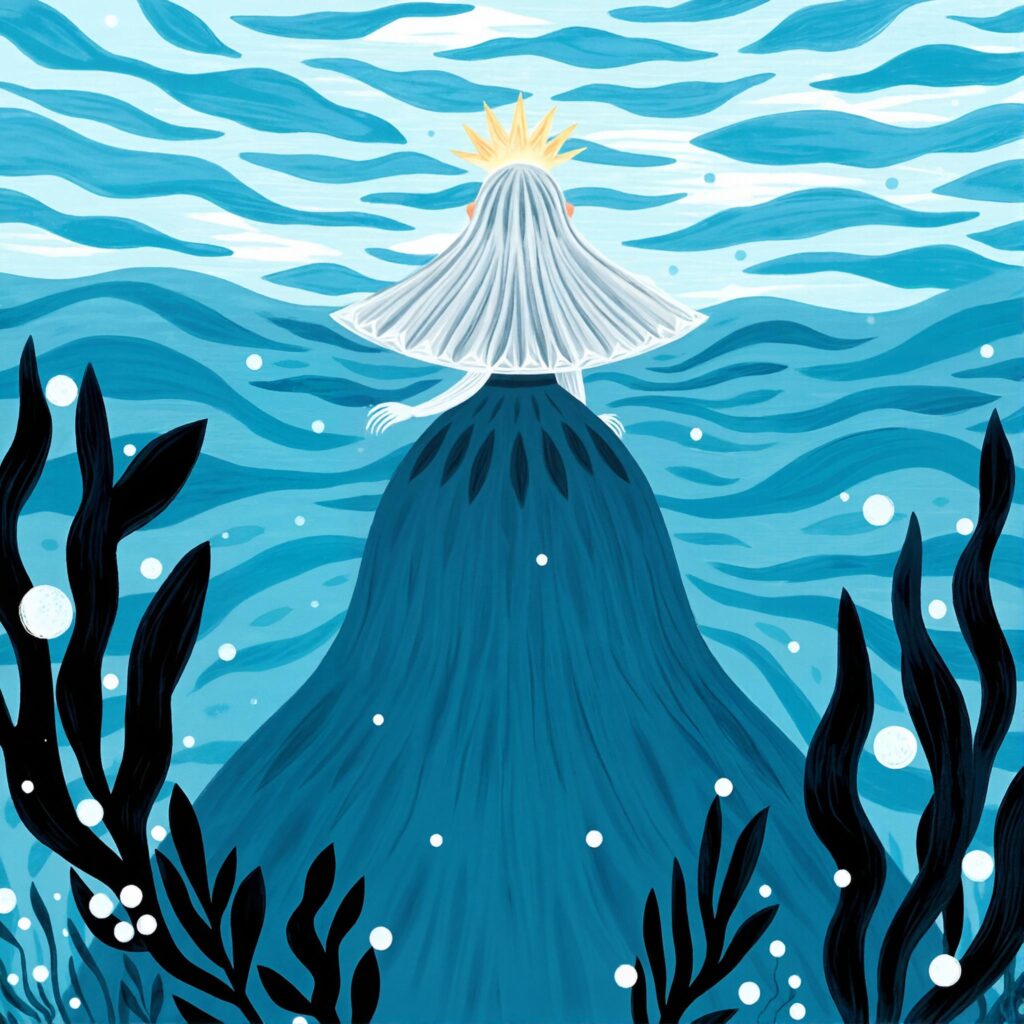
The Deep Sister — Lady of the Boundless Blue — She Who Chose the Dark
“The sea does not hate the sailor. It simply does not accommodate him.”
At a Glance
| Status | Living; rules the Boundless Blue and Cerulean Sea — present and active, though rarely manifested in mortal form |
| Alignment | True Neutral — the sea is neither cruel nor kind; Limnas has become the sea in every meaningful sense |
| Domain | Ocean depths, sea creatures, the boundary between surface and deep, maritime fate, the unknowable, love as a force that generates monsters |
| Symbols | A spiral shell; a lighthouse going dark; the horizon where sky meets water; a sailor’s compass pointing somewhere that isn’t north |
| Divine Tier | Divine — daughter of Danu; her domain is vast and her power within it is essentially absolute |
| Titles | The Deep Sister, Lady of the Boundless Blue, The Mother of Sea-Monsters, She Who Took the Ocean as a Lover, The Third Daughter |
| Known Kin | Mother: Danu. Sisters: Lilith, Lysandra. Lovers: Ceto, Ebisu, Kukulcan, Chaac — each fathered different categories of ocean creature. Her children are the sea’s monsters. |
| Relationship to Dagon | Careful, mutual, ancient. She named him kin. He respected the naming. The longest unbroken peace in Once. |
Part One: The Sister Who Went Down
Limnas and the Ocean’s Call
Of Danu’s three daughters, Limnas is the one who changed most completely. Lilith was exiled but remained herself — her nature sharpened rather than transformed by suffering. Lysandra stayed on the surface and watched mortals and retained a recognizable if uncomfortable personality. Limnas went into the ocean, and the ocean absorbed her, and what came back up — what still sometimes surfaces in a wave’s particular quality or a storm’s specific mood — is only partially the being who went down.
She went to the sea because it was the one domain the One God had never been able to claim. His hierarchy requires acknowledgment, and the ocean acknowledges nothing. It does not organize itself into ranks. It does not have a chain of command. It has depth, and pressure, and the accumulated enormity of everything that has ever drowned, and she found in that enormity a peace that the surface world, with its endless political negotiations and divine wars, had never offered her.
Her lovers — Ceto, Ebisu, Kukulcan, Chaac — were gods of the sea in various traditions, each one a different expression of the ocean’s nature. Her children by them are the monsters that guard the world’s waters: krakens, sea serpents, the Sahugin that patrol the deep trenches. She did not create them as weapons. She created them as family, as companions in the deep, as beings suited to a world the surface cannot reach. That they are terrifying to sailors is incidental to her. She did not make them for sailors.
The border she maintains with Dagon is the most interesting diplomatic fact in Once. She named him kin and paid tribute and kept her children away from his deepest territory, and he has respected it for ten thousand years. She does not trust him. She simply recognized, early, that the alternative to peace with something that ancient and that powerful was a war the ocean itself might not survive.
Part Two: Nature, Character, and the Sea’s Logic
True Neutral and What It Costs
Limnas is True Neutral in the deepest sense, and she is the only one of the primordial figures in Once about whom this is unambiguously true. The One God has law. Danu has goodness. Dagon has hunger. Lilith has defiance. Limnas has the sea, and the sea has no alignment — it simply is, enormously and without apology, and she has made herself into that same quality of existence.
This makes her, paradoxically, the safest of the primordial figures to interact with. She does not want anything. She does not have an agenda. She does not find mortals fascinating the way Lysandra does or threatening the way the One God does or relevant the way Danu does. She will answer a direct, respectful question with a direct answer. She will accept an honest offering — something genuinely given, not strategically given — with genuine acknowledgment. She will not grant wishes, make bargains, or extend patronage. She will, sometimes, simply not drown you when she could.
| Trait | Expression in Play |
|---|---|
| Communicates in the sea’s terms | She does not speak in the way a person speaks. She speaks in the way the ocean speaks: in tides, in the behavior of sea creatures, in the specific quality of a storm that is either warning or welcome. Players who can interpret natural phenomena as language will understand her better than players who expect words. |
| Not cruel but utterly without accommodation | She will not hurt the party. She will also not make herself inconvenient for their benefit. If her domain is in the way of where they need to go, she will not move it. She will, perhaps, make a path. |
| Deeply aware of the Dagon threat | She knows what the Rising Deep means — she has been maintaining the border with his domain for ten thousand years and she knows what is on the other side of it. She will not fight for the party. She will share information, precisely and once, if asked in the right way. |
| Her children are not weapons | Krakens, sea serpents, Sahugin are her family. They attack ships because ships are in their territory, not because she sent them. Asking her to control them is like asking a parent to prevent their children from existing. She will not. |
| Tirulia’s bargains run through her | The sea-deity arrangements that give Tirulia its maritime prosperity were made with beings in her domain. She is aware of them. She considers them reasonable. If those bargains are threatened or broken, she will notice, and Tirulia will feel it. |
Leave a Reply