Dagon, Prince of the Darkened Deep
Origins: Before the World Was Named
In the age before mortal kingdoms, before the One God arrived to set his hierarchy upon a dreaming world, there was the sea — and within the sea, something older than gods.
The entity that would come to be called Dagon was not created. It accumulated. Where cold met crushing darkness, where the bones of proto-continents fractured and sank, a consciousness coalesced from the ocean’s own nightmares.
The goddess Limnas, daughter of Danu, encountered Dagon early in her sovereignty and made the only wise decision any being has ever made in his presence: she named him kin, paid tribute, and kept her children away from his deepest territory. That boundary has held for ten thousand years — the longest unbroken peace in the history of Once. Everyone else who has dealt with Dagon has come to regret it.
Nature and Domains
Dagon is not, precisely, evil — evil is too small a category for what he is. He is the sea’s own logic, applied without mercy: the pressure that collapses structures not built to bear it, the tide that takes without asking and returns nothing it does not choose to return.
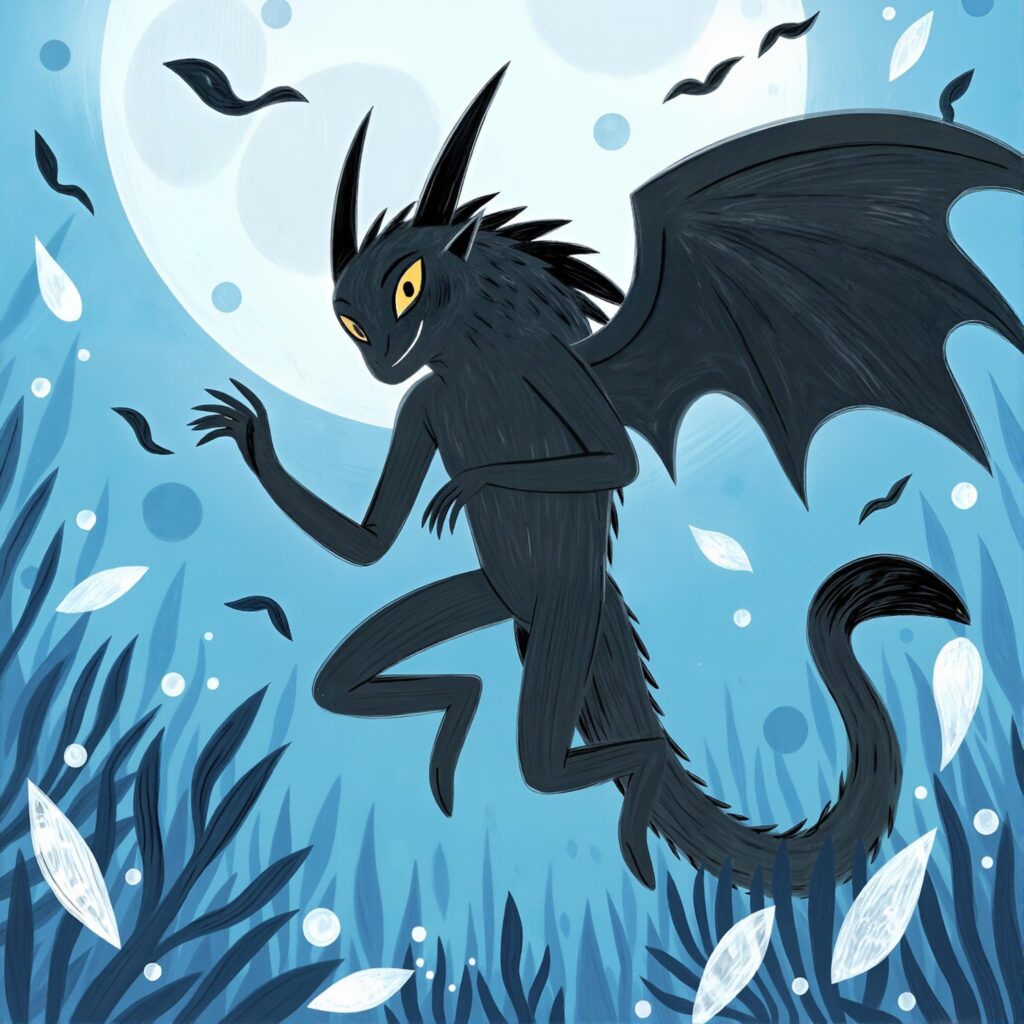
His physical form, when he chooses to manifest one, is a monstrous amalgamation of deep-sea life and ancient deity. But Dagon rarely manifests. His influence moves through water and dream and the slow, patient corruption of those who live near the sea.
| Domain | Expression |
|---|---|
| Water and Darkness | Tides, deep currents, bioluminescent life. Coastal prosperity, full nets, calm harbors — quiet gifts that accumulate debt. |
| Madness and Dreams | He plants visions like barnacle spores — often beautiful, always inescapable. Dagon does not compel. He invites. |
| Corruption and Mutation | Worship or proximity causes Riving: gills, widened eyes, mottled luminescent skin. Not punishment — incorporation. Those who survive it fully are the Riven. |
The Ancient Debt: Germonia’s Bargain
Five centuries ago, a desperate lord of what would become Germonia found a way to the sea and offered Dagon what he always wanted from the surface world: not gold, not territory, but blood — the promise of a daughter of the bloodline, given in a future generation of Dagon’s choosing. The lord won his war. His line flourished into the royal house that produced Snow White. The bargain was forgotten by the world. Dagon did not forget.
“One member of the line secretly bargains with Dagon, trading the promise of a daughter of the bloodline for future dominion over all of Grimm. The deal is soon forgotten — but Dagon does not forget.”
The debt has come due twice in living memory: first with the Midnight Twins (changelings, children of Dagon and the Witch Queen Nicnevin), and now with Princess Sable, the last daughter of Snow White’s Germonian bloodline. Dagon wishes to marry her. She is thirteen. Snow White attempted to negotiate by offering Sable willingly — Sable killed her mother first, then offered Dagon her mother’s body as a down payment. The original contract remains open. It will not be resolved by negotiation.
The Rising Deep: Dagon’s True Purpose
The bargain with Germonia was practical. What lies beneath it is theological. Among Dagon’s oldest cults there is a prophecy called the Rising Deep — not a future possibility, but a description of the primordial condition of the world, before land imposed itself on water, restored.
“When the bell of the drowned cathedral tolls, and seven storms crown the sky, the Prince shall rise from his throne of teeth.”
Every civilization linked to Dagon in the historical record — Atlantea, Mor’Duun, the coral spires of Seraphyx — followed the same arc: rapid advancement, deep oceanic magic, hubris, then submergence. These were not accidents. They were rehearsals. Once is the final performance.
The Rising Deep has not yet occurred because of three ancient seals — the Kraken’s Tooth, the Sunken Bell, and the Throne of Teeth — each a convergence of a physical anchor, a metaphysical condition, and a guardian force. Maevis’s sacrifice closed the first seal, but the act of opening it told Dagon the seals can be breached. He has redirected his entire operation toward the remaining two.
The Three Seals, Briefly
| The Kraken’s Tooth | Sunk in the Abyssal Trench at 8,000 feet. Operates on sacrifice — it only accepts what is genuinely, freely given. Maevis’s selfless sacrifice closed it; her pearl remains, dreaming. |
| The Sunken Bell | In the drowned Cathedral of Mor’Duun. Operates on silence — it must never ring freely. Guarded by the Deep Wretches, drowned priests immune to charm. |
| The Throne of Teeth | In the Chasm Eternal, the planar extension of the Trench. Operates on sovereignty — Dagon can only be displaced by a counter-claim so complete the domain itself reorients away from him. |
The Deep Choir
Dagon’s oldest continuous institution, older than the kingdoms of Once. It does not sing for Dagon — it sings as Dagon, channeling his call through trained human throats. Its structure runs from Initiates (the Submerged) through Choir Members (the Resonant) to the Riven (Deep Servants), led by the anonymous Prophet of the Void, a being so far along in Riving that Dagon can speak through them directly.
DM NOTE
DM Note: Dagon cannot be permanently destroyed by combat — reducing him to zero hit points only triggers his True Form and floods the surrounding area. He can only be displaced from the Throne of Teeth by an act of counter-sovereignty. Maevis’s pearl — a gift with no strings attached, the exact opposite of every transaction Dagon has ever made — is the only thing he has never encountered and cannot absorb.
Leave a Reply