Alice
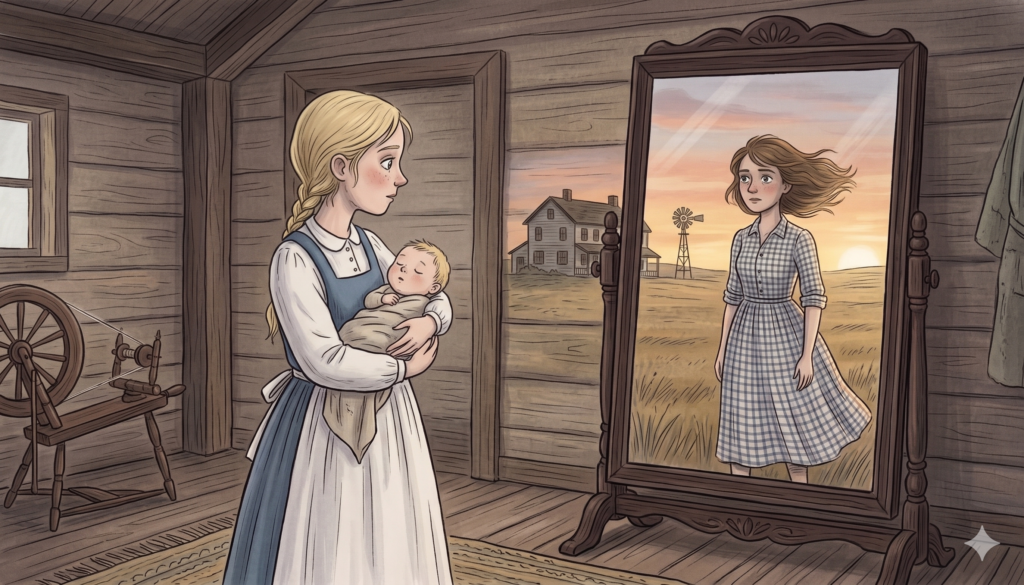
The Girl Who Kept Falling — The Wanderer Between Worlds — She Who Chose to Stay
“Curiosity got her in. Love is what made her stay. She has never fully decided which decision frightens her more — and most days, she does not let herself ask.”
At a Glance
| Status | Living; in hiding somewhere in Gillikin Country, surviving quietly under Glinda’s purges |
| Alignment | Neutral Good — gentle, fiercely brave when it matters, increasingly guarded after everything she has lost |
| Domain | None divine. A mortal of the outer world with an unusual sensitivity to the thin places between it and Once — doors, mirrors, rabbit holes, the backs of wardrobes |
| Symbols | A pocket watch stopped at the wrong hour; a small unlabeled bottle she has never dared drink from again; an oversized brass key with no door it fits; a white rabbit glimpsed only out of the corner of the eye |
| Divine Tier | None. Fully mortal, with no bloodline connection to Once at all — which is, depending on who you ask, either the least interesting or the most interesting thing about her |
| Titles | The Girl Who Fell, the Wanderer, Lady Alice of Gillikin (by a marriage that no longer offers her any protection) |
| Known Kin | An older sister, left behind in her own world, never told what became of her. A husband, a Gillikin prince, status uncertain since the purges began. A daughter, sent away as an infant — destination unknown, fate unknown, the wound Alice has never stopped carrying. |
| Her contradiction | She spent her entire childhood trying to get back to Wonderland. She spent her adulthood trying to get her daughter as far from this world as the world would allow. |
Part One — The Girl Who Kept Falling
A Door That Should Not Have Opened
Alice was, by every account she gives of herself, an unremarkable child from an unremarkable corner of her own world — until the day she followed a rabbit in a waistcoat down a hole that had no business existing and found herself somewhere that the laws of her world had never been informed about. Wonderland did not explain itself to her. It has never explained itself to anyone. It simply received her, the way a tide receives a shell, and let her work out the rest on her own.
She came back. This is the part of her story people find hardest to credit: a child falls into an impossible place once, by accident, and that should be the whole story. Alice’s was not. The door, once opened, did not fully close, and for years afterward she found herself slipping through — in dreams that weren’t dreams, in mirrors that held her gaze a half-second too long, in moments of looking away and looking back to find the room subtly wrong. She told no one back home what was happening to her. There was no version of the explanation that did not sound like madness, and she had already noticed that the adults around her were eager for a reason to call her strange.
What Wonderland Does to a Curious Child
Wonderland is not kind to visitors, exactly, but it is honest with them in a way few places are: it shows you immediately and without apology what you are. Alice met the Chimeric Council’s politics, the Queen of Hearts’ temper, a Cheshire smile that told more truth grinning than most people manage speaking plainly, and she came away from each encounter a little more herself and a little less certain that “herself” was a fixed thing. She grew up between two worlds without ever fully belonging to either, which made her sharper than her peers in the one and stranger than the locals in the other.
DM NOTE
Whether Wonderland chose Alice, or whether she simply happened to be a child capable of noticing a door that most people would have walked past, is left deliberately unresolved. Alice herself does not know, and has stopped trying to decide. A DM is free to treat her as the rare mortal with a genuine, inexplicable gift for slipping between worlds — useful, narratively, as one of the only reliable sources in Once who has firsthand knowledge of how thin places actually work.
Part Two — Settling, Marriage, and the Daughter She Lost
Why She Stopped Leaving
Wonderland’s chaos, for all its wonder, is exhausting to live inside permanently, and somewhere in her early adulthood Alice found herself drawn instead to Oz — governed, structured, recognizably a place with seasons and architecture and people who kept their promises more often than not. She met a Gillikin prince there: kind, curious himself in a quieter way, unbothered by the fact that his intended had a habit of vanishing for hours and returning with sand from a desert that didn’t connect to anywhere nearby. They married. For a time — under Glinda’s early, beloved reign — Oz felt like the safest place either world had ever offered her. She let herself believe she had finally landed somewhere for good.
They had a daughter. Alice has never told anyone the daughter’s first name in any account that has survived contact with the party, and it is unclear whether this is grief, caution, or some combination she has never untangled.
The Purges and the Looking-Glass
When Glinda’s hunt for “the pure” reached the Gillikin court, Alice understood with the particular speed of someone who has already watched one home turn dangerous that beloved was not going to be enough to protect her family this time. She did not wait for confirmation. She took the one tool she had that nobody else in Oz could reliably use — a looking-glass, and the same thin-place sensitivity that had been pulling her sideways through the world since she was a child — and she sent her daughter through it, aiming for her own sister, back in the world she had left so long ago.
She missed. Whether by the glass’s imprecision, the panic she was working under, or some property of crossing between worlds that nobody fully understands, her daughter did not land with Alice’s sister. She landed somewhere else entirely — and Alice has spent every year since not knowing where, raising the question that has not stopped costing her sleep: did the spell fail completely, or did it simply send her daughter somewhere Alice has not yet learned to look?
DM NOTE
The imprecision of looking-glass travel between worlds — especially cast in panic, especially across a boundary as unstable as the one between Once and the outer world — is the mechanical excuse for why Alice’s daughter ended up nowhere near her intended destination. This should remain genuinely uncertain to Alice herself; she has theories, she has hope, and she has no confirmation. If the party ever connects Alice to Dorothy Gale, the reveal belongs to the table, not to a lore dump — Alice should ask more questions than she answers, at first.
Part Three — Personality, Character, and How to Play Her
Alignment: Neutral Good
Alice has spent her life being underestimated by people who mistake her gentleness for naivety, and she has long since stopped correcting them out loud — it is more useful to let people discover the mistake themselves, usually at an inconvenient moment for them. She is kind by disposition and brave by necessity, and the years since the purges have layered a watchfulness over both qualities without managing to extinguish either.
| Trait | Expression in Play |
|---|---|
| Politely, thoroughly unshockable | She has seen a tea party run by a hatter who never stops, a cat that exists in fractions, and a queen who beheads people for sport. Very little the party can show her will actually surprise her, though she is gracious enough to look surprised when it would be rude not to. |
| Asks better questions than she answers | Alice has spent a lifetime being interrogated by both worlds about who she is. She has gotten extremely good at redirecting that interrogation elsewhere, often without the other person noticing they’ve been redirected. |
| Carries her grief like a coat she never takes off | She does not bring up her daughter unprompted. If someone else does, watch carefully — there is a flicker before she composes herself, and what she says next is always more careful than what she almost said first. |
| Genuinely, instinctively kind to the lost | Children, runaways, anyone displaced from where they’re supposed to be — Alice’s attention goes to them immediately and without calculation. It is the truest thing about her, and the thing most likely to put her in danger again. |
| Knows more about thin places than she lets on | She has decades of firsthand experience crossing boundaries that most scholars in Once only theorize about. She rarely volunteers this. She will not refuse a question asked with genuine need behind it. |
Alice in the Campaign
Alice is one of the few people in Once who can speak with real authority about how travel between worlds actually works — not the theory, but the lived, frightening, imprecise reality of it. A party investigating thin places, looking-glass magic, or the mechanics of how something might cross from the outer world into Once (or back) will eventually find their way to her, whether they’re looking for her specifically or not.
The deeper hook is the one she does not know she’s offering: if the party has any connection to Dorothy Gale, or has heard the name Henry and Em’s Kansas farm, the recognition — when it comes — should belong entirely to the table. Alice does not know her daughter survived. She does not know what name was given to her, or where she landed, or whether the woman she sent through the glass grew up safe, resentful, loved, or some complicated combination of the three. A reunion between Alice and Dorothy, handled with care, is one of the most quietly devastating moments this campaign can offer — and it does not need to be engineered. It only needs the party to ask the right question of the right person, twice, in two different worlds.
Leave a Reply