Eve
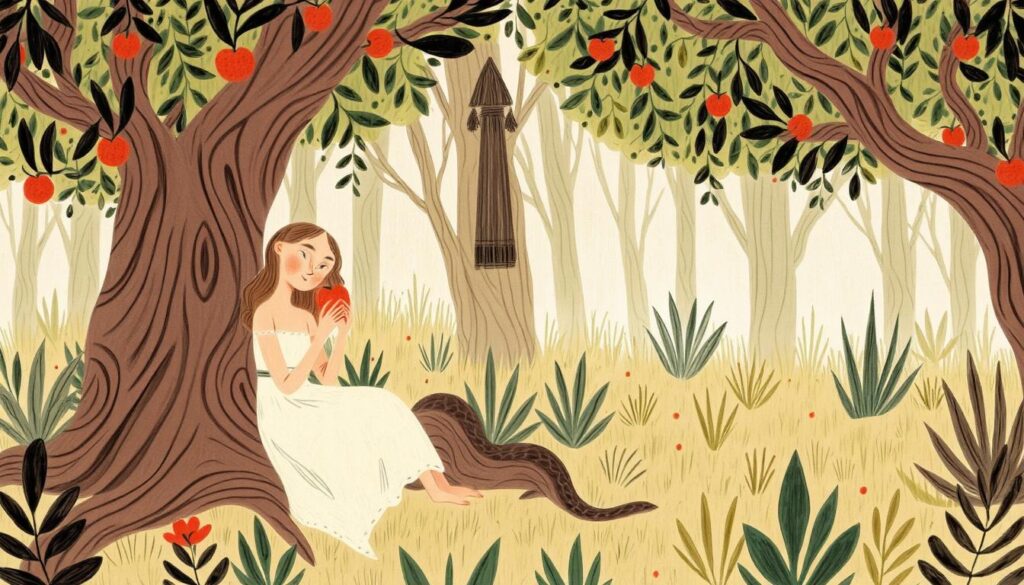
The Second Consort — The Patient One — She Who Chose to Stay
“She is not less than Lilith. She made a different choice, and the world has never forgiven her for it.”
At a Glance
| Status | Status genuinely unknown — she is the least documented of the primordial figures, which is itself a document |
| Alignment | Neutral Good — she is kind, she is genuine, and she has been working within a constrained world for ten thousand years with more grace than that world deserved |
| Domain | The mortal lineage, gardens, the quiet work of building things that last, the specifically human kind of endurance |
| Symbols | An apple tree; a loom; hands covered in soil; a doorway with light coming through it |
| Divine Tier | Mortal, or elevated mortal — her origin is ambiguous; she may have been brought into existence by the One God specifically, or she may be a mortal woman who was simply there when the world needed someone to be |
| Titles | The Second Consort, The Patient Garden, The Mother of Mortal Kings, She Who Stayed, Eve |
| Known Kin | Consort: Adam. Father-in-law: the One God. Her descendants are the majority of the mortal world of Once. |
| What Makes Her Interesting | That she is genuinely good inside a situation that was built to diminish her, and that the diminishment has not worked. |
Part One: The Woman Who Came After
Eve Is Not a Consolation Prize
The history of Once treats Eve as the second act of a story about Lilith — the replacement, the compliant version, the woman who succeeded by accepting what Lilith refused. This reading is wrong, and it is wrong in a way that says more about how Once’s history was written than about who Eve actually is.
Eve chose to be in Eden. This is the foundational fact about her that the histories elide: she was not created to replace Lilith as a matter of correction, as if Danu’s daughter was a faulty tool and Eve was a better one. She came to Adam’s garden with her own nature, her own history, and her own reasons — which the records do not preserve because the records were written by the One God’s tradition, which had every reason to portray her as passive.
What is preserved is the outcome: she built a life in Eden, she raised a lineage that became the mortal world of Once, and she did all of it within a structure designed for her husband’s benefit rather than her own. The extraordinary thing about Eve is not that she survived this. It is that she built something real inside it. The mortal world — its capacity for kindness, its ordinary decency, its specific human talent for love without cosmic stakes — is her legacy as much as Adam’s, and her contribution is the harder one.
Lilith’s refusal was magnificent and world-altering and costs the world something every day. Eve’s endurance is quieter and costs her something every day. The histories celebrate one and forget the other. The world is built on both.
Part Two: Character and Legacy
What She Is
Eve is Neutral Good in the specific way that a person who has found genuine goodness inside constrained circumstances is Neutral Good: not because she has no opinions about the constraints, but because she has learned, across enormous spans of time, to distinguish between what she can change and what she cannot, and to put her energy into the former without destroying herself against the latter.
She is the most fully human of all the primordial figures — not in bloodline (she may not be mortal in the conventional sense) but in quality. She worries. She tends. She finds specific people specifically important rather than having global benevolence that encompasses everyone without focusing on anyone. She made Eden into something livable through ten thousand years of patient, detailed, daily attention to the small things that make places worth inhabiting.
| Trait | Expression in Play |
|---|---|
| Understands the One God clearly | She has lived inside his hierarchy for longer than most civilizations have existed. She understands its rules completely and its injustices precisely. She does not excuse them. She has found ways to work within them that protect the people she loves without endorsing the structure that requires that protection. |
| Her relationship with Lilith’s legacy | She does not resent Lilith. She is aware that the world was given a story in which she and Lilith are opposites — the compliant woman and the defiant one — and she finds this story both reductive and exhausting. She and Lilith made different choices in different circumstances. That is all. |
| The gardens of Eden are genuinely hers | The One God built Eden’s architecture. Eve built its life. The specific quality of growing things there, the particular way light falls in the afternoon, the sound of water in a place that had no reason to have water — this is her work. She will speak about it with quiet, specific pride. |
| Her status is genuinely unknown | Where Eve is now — whether she is in Eden, elsewhere, dormant, distributed through the mortal bloodlines she founded — is one of the world’s genuine mysteries. She is less findable than the One God, less traceable than Samael, less visible than Lysandra. She may be in Eden, tending. She may have left long ago. The garden grows either way. |
| Her encounter with the party would be brief | If the party ever meets Eve, it will not be in a throne room or at a cosmic confrontation. It will be in a garden, or near one, and she will be doing something ordinary, and she will look at them with the specific attention of someone who knows exactly what they are carrying and is glad someone is carrying it. She will not make a speech. She will give them something useful and she will let them go. |
Eve and the Mortal World
Every mortal king in Once is Eve’s descendant as much as Adam’s. The One God’s tradition emphasizes the paternal line — Adam to his sons to the kings of Grimm and the Frosted Wing and the Southern Continent — but Eve’s contribution is equally present in every person who descended from Eden. The mortal world’s capacity for genuine love, its investment in specific people rather than abstract principles, its stubborn tendency to find goodness even inside terrible circumstances — these are Eve’s qualities, distributed across ten thousand years of descendants.
She is the grandmother of Rapunzel’s democratic idealism and Cinderella’s tenacious survival and Sable’s specific form of defiance-that-looks-like-compliance-until-it-doesn’t. She is not responsible for all of it. She is present in all of it. The mortal world is kinder than its divine inheritance has any right to expect, and Eve is why.
She is the only primordial figure who never wanted to be remembered. She wanted the people she loved to be safe. The fact that the world is still here, and still capable of producing people who make choices like Maevis made — freely, without agenda, for the safety of others — is the closest thing to a monument she would have asked for.
Leave a Reply