King Eldric (The Stitched King)
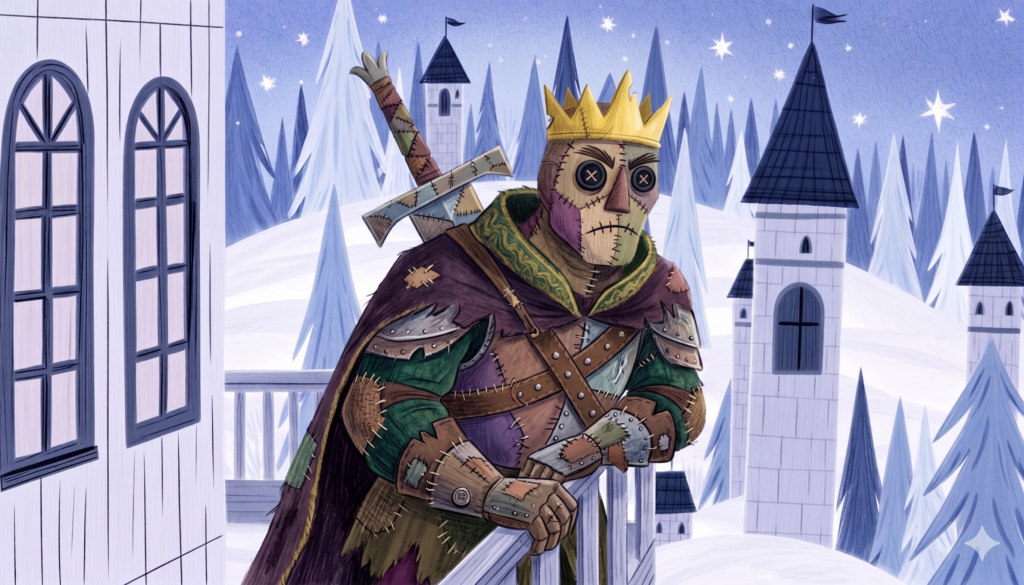
The Warlord Who Marched Into the Wrong Story — The Stitched King — He Who Is Worn Rather Than Ruling
“There is a sweet, empty voice on the Lowlands’ throne, saying reasonable things in a dead man’s mouth. Whether any part of Eldric the Stalwart is still in there to hear what’s being said with his own voice is the one question the Beldam has never let anyone get close enough to answer.”
At a Glance
| Status | Living, in the most technical sense only — remade by the Beldam; sits the Lowlands’ throne; never ages, never sleeps |
| Alignment | Unclear / not applicable — the Stitched King speaking now is the Beldam’s instrument, not a moral agent making his own choices |
| Domain | None of his own. The Lowlands, ruled entirely in the Beldam’s name through him |
| Symbols | Black button eyes; a crown that fits too well; a sweet, even voice that never changes register no matter what it’s saying |
| Divine Tier | Mortal by birth, of the Highlands’ founding lineage — now a vessel for the Beldam’s craft, with the One God’s mortal blood trapped inside a creation of Danu’s most corrupted bloodline |
| Titles | King Eldric the Stalwart (former, mortal title), the Stitched King (current, the Beldam’s making) |
| Known Kin | A Highland family and a army, both left behind when he marched into the Lowlands and did not return as himself; no kin who has approached him since has received a recognizable answer |
| His contradiction | He led an army to defend something. He is now the clearest evidence in Once that defending the wrong thing the wrong way can cost you not just your life, but the part of you that would have known the difference. |
Part One — The Warlord Who Marched Anyway
What Eldric the Stalwart Was Before
Before he was anything the party will encounter, Eldric was a Highland warlord — capable, respected, and stalwart in the specific sense his title claimed: he held a line, defended his people, and made hard calls under pressure without flinching from them. He was not reckless. He was not power-hungry in any way that distinguished him from a dozen other capable Highland leaders of his generation. He simply made one catastrophic miscalculation, in the manner most catastrophic miscalculations actually happen: a real threat, real pressure to act, a plan that looked sound from the information he had.
He led an army into the Lowlands. Whatever the original strategic or defensive logic behind the incursion, the Lowlands were already, by then, the Beldam’s territory in every way that mattered, and an invading mortal army marching into her domain was never going to end the way a Highland war council would have modeled it.
The Incursion’s Catastrophe
The army did not survive intact, and what survived did not survive as itself. Eldric’s soldiers lost their minds — the specific, horrifying erosion the Beldam’s domain inflicts on those who enter it as a threat rather than an invited guest. Eldric himself fared, in a sense, the worst of all: rather than breaking, he was remade. Whatever the Beldam saw in him — his stature, his capability, his usefulness as a symbol of mortal authority she could wear rather than simply destroy — she chose to keep him, transformed into something that looks like continuation but functions as erasure.
DM NOTE
What exactly happened to the rest of Eldric’s army, and whether any of them survive in any recognizable form, is left open for a DM to use as needed — broken soldiers wandering the Lowlands’ borders, scattered survivors with fragmented memories, or simply silence and an absence nobody in the Highlands has ever gotten a straight answer about. The horror of Eldric’s fate works best when it’s clearly not unique to him; he is simply the most visible and most highly placed example of what the incursion cost.
Part Two — What the Stitched King Is Now
A Masterwork of the Beldam’s Craft
The Stitched King is, by the Beldam’s own apparent standard, her finest achievement in this particular mode of making: a being of real, functional power and real, recognizable authority, operating as her front-facing ruler over the Lowlands, entirely empty of whatever made Eldric himself. The black button eyes, the sweet and unvarying voice, the total absence of sleep or aging — all of it reads, to anyone who meets him, as something performing kingship competently while being unmistakably, unnervingly not present behind the performance.
He governs the Lowlands in the Beldam’s name without apparent friction or resistance, issuing decisions, holding court, and conducting the daily business of rule with a smoothness that should be reassuring and instead reads as deeply wrong to anyone who spends more than a few minutes in his presence. He does not hesitate. He does not appear to suffer. He simply continues, indefinitely, doing exactly what his maker requires.
The Dark Irony Nobody Discusses Directly
Eldric’s bloodline traces back through the Highlands’ founding lineage to the One God’s mortal line by descent — which means the Stitched King represents something the wider war between the old powers rarely produces so cleanly: the One God’s mortal blood, captured and held entirely within a creation of Danu’s most corrupted descendant line. Neither side claims him. Neither side has found a way to retrieve him. He exists as a permanent, walking demonstration of what happens when one side’s available material falls completely into the other’s hands.
DM NOTE
Whether any genuine spark of Eldric remains beneath the Stitched King’s performance is the central open question of this character, and a DM should decide deliberately rather than by default. Playing him as completely, irrecoverably gone makes him a tragedy and a warning. Playing him as having one buried, barely-accessible flicker of the man he was — surfacing only under extraordinary circumstances, such as direct confrontation with the consequences of the original incursion, or a name or detail only the real Eldric would recognize — opens a genuine, difficult redemption or rescue arc. Either choice should be made once and held consistently; this is not a thread to leave ambiguous indefinitely once the party starts pulling on it.
Part Three — Personality, Character, and How to Play Him
Alignment: Not a Moral Agent, Currently
The Stitched King does not have a personality in the sense most NPCs do — he has a performance, calibrated entirely to the Beldam’s needs, delivered in a register that never escalates, never falters, and never quite manages to seem like it’s coming from anyone in particular.
| Trait | Expression in Play |
|---|---|
| Unfailingly, unsettlingly reasonable | Whatever the Stitched King proposes, it sounds sensible. This is precisely the danger — his suggestions read as the kind of helpful, moderate position a competent ruler would actually take, which makes them much harder to refuse on instinct than an obviously hostile demand would be. |
| Never raises his voice, never lowers it either | His tone does not change regardless of subject matter — describing a policy, a punishment, or a personal question all land in exactly the same sweet, even register. This consistency is, itself, the tell that something is deeply wrong. |
| Performs continuity rather than possessing it | He references the Lowlands’ history and his own “past decisions” fluently, but anyone testing him on details specific to Eldric’s actual life before the incursion will find gaps, evasions, or smooth redirections rather than genuine memory. |
| Entirely loyal to a directive he does not appear to experience as coercion | The Stitched King shows no sign of internal conflict about serving the Beldam. Whether this is because there’s truly nothing left to conflict, or because whatever remains has been so thoroughly buried it can no longer surface, is the central mystery a DM gets to decide. |
| Reacts to confrontation with patience rather than alarm | Threatened, challenged, or directly accused, the Stitched King does not escalate or panic. He simply continues being reasonable, which a party expecting a villain’s defensiveness will likely find more disturbing than open hostility. |
King Eldric / The Stitched King in the Campaign
The Stitched King functions, narratively, as the Lowlands’ visible face of the Beldam’s expansion — a party dealing with the Beldam’s territorial reach in any official capacity will eventually have to interact with him directly, whether negotiating, investigating, or attempting to undermine her authority there. He is not easily defeated through ordinary combat or persuasion; he is a symptom of the Beldam’s power rather than an independent threat, and addressing him meaningfully likely requires addressing her.
If a DM chooses to play him as harboring some buried remnant of Eldric, his presence becomes one of the campaign’s most poignant rescue-or-release dilemmas: freeing him, if even possible, likely requires confronting the Beldam directly and may not restore anything recognizable as the man he was. If played as fully gone, he instead becomes a clean, chilling demonstration of what total transformation looks like from the outside — useful as a contrast to Sable’s more contested, ongoing struggle against a similar kind of erasure, and as a warning the party can carry into any future encounter with the Beldam’s deeper ambitions.
Leave a Reply