Lysandra
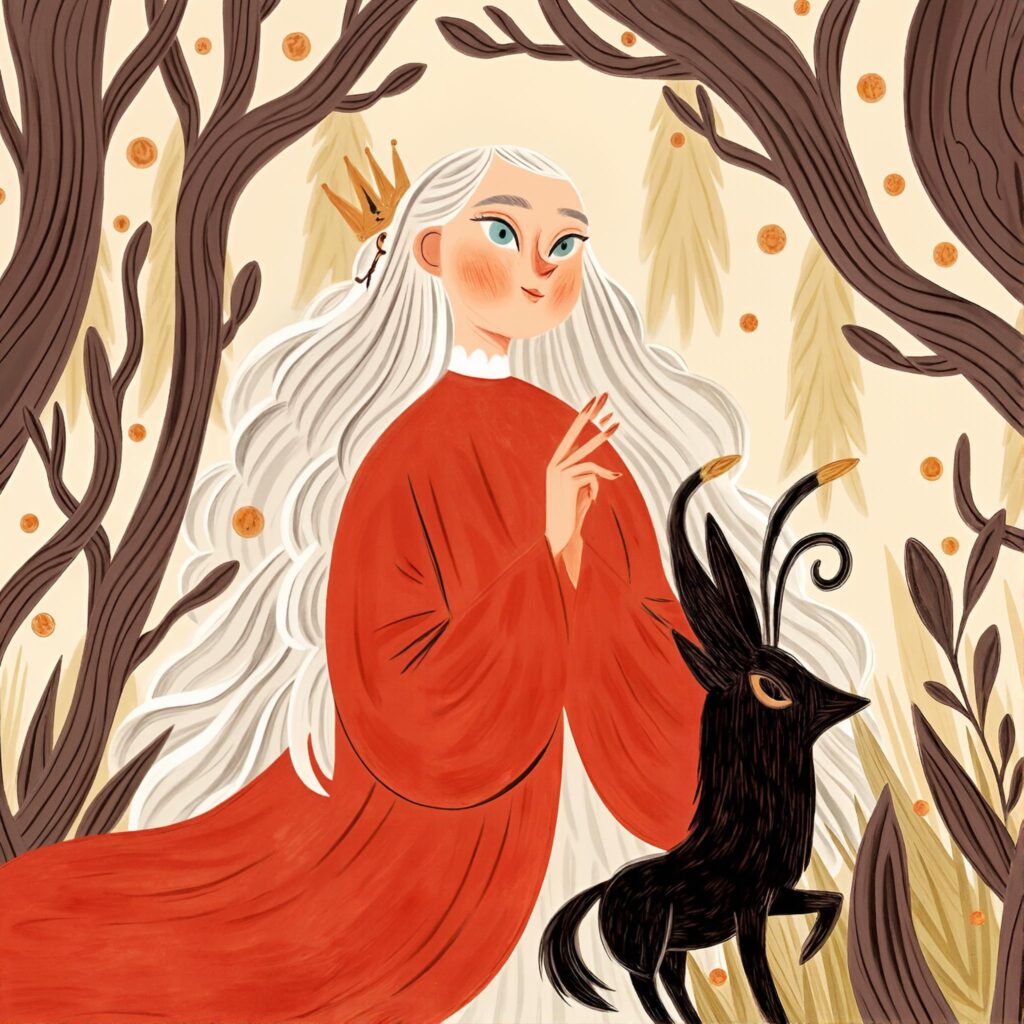
The Kingmaker — The Amusement-Seeker — She Who Lifts and Topples
“She does not want to rule. She wants to watch what happens when she moves the pieces.”
At a Glance
| Status | Presumably living and currently active — her fingerprints are on at least three ongoing succession crises in Grimm |
| Alignment | Chaotic Neutral — she is not malicious but she is entirely indifferent to the suffering her amusements cause |
| Domain | Mortal ambition, royal succession, political intrigue, the long game, fate that is actually choreography |
| Symbols | A scale with unequal weights; a crown being passed from one hand to another; a fox; a silver thread running through a tapestry |
| Divine Tier | Demigod or divine — daughter of Danu; her power is primarily subtle influence rather than overt force |
| Titles | The Kingmaker, She Who Stirs, The Invisible Hand, The Laughing Sister, The Player of Games |
| Known Kin | Mother: Danu. Sisters: Lilith, Limnas. She has no consort and no acknowledged children — her investment is in mortal bloodlines, not her own. |
| Motivation | Pure, undiluted entertainment. She finds mortal political drama endlessly fascinating and has been running it like a personal theater for millennia. |
Part One: The Sister Who Stayed
While Lilith was exiled and Limnas went to sea
When the Divine Schism settled and Danu’s daughters came into their distinct natures, Lilith went south into exile and grief and defiance, and Limnas went deep into the ocean’s mystery, and Lysandra looked at the surface world — the mortal kingdoms just beginning to organize themselves, the small figures of kings and queens making enormous decisions — and she did not go anywhere. She stayed. She watched. And after a while, she started to participate.
Not in the way a goddess participates — she has never wanted to rule, never wanted worship, never wanted acknowledgment. What she wanted was more interesting than any of that: she wanted to see what would happen. The mortal kingdoms were a story still being written, and she discovered, somewhere in the first few centuries of watching, that she could add a word here, a turn there, a whispered suggestion in the right ear at the right moment, and the story would go somewhere entirely unexpected. She found this delightful.
She has been doing it ever since. The five-hundred-year civil war that fractured Grimm — her suggestion, introduced in the ear of the dying king Hammond as he considered whether to legitimize his bastard son Stephan. The Hinterlands succession dispute that installed Aurora and the ambitious Phillip — she was there, in the background, making certain the right people were in the same room at the right moment. Tirulia’s complicated relationship with its sea-deity bargains almost certainly involved her arranging a meeting between a desperate coastal king and a representative of Limnas’s domain.
She does not think of herself as malicious. She thinks of herself as a writer who occasionally steps into the story. That the story she is writing involves the suffering of real people is something she acknowledges in the abstract and does not feel in the particular. She has been watching mortals for ten thousand years and has maintained the specific emotional distance that makes them interesting rather than real to her.
Part Two: Nature and Character
The Problem with Pure Amusement
Lysandra is Chaotic Neutral in the purest possible sense, and she is the most immediately dangerous of Danu’s three daughters precisely because her dangerousness is invisible. She does not threaten. She does not demand. She smiles and she watches and she occasionally murmurs something to someone who matters, and then she waits to see what the murmur grows into.
She is charming in person — genuinely, effortlessly charming, with the specific warmth of someone who finds people fascinating and lets that show. She asks good questions. She listens to the answers. She makes the person she is speaking with feel seen and interesting and important. None of this is false. She does find them fascinating. She is also filing away everything they tell her for future use.
| Trait | Expression in Play |
|---|---|
| Genuinely finds mortals delightful | Not in a condescending way — in the way that someone who loves theater loves the actors. She is interested in motivations, in contradictions, in the gap between what people say they want and what they actually want. She will notice this gap in the party before the party notices it themselves. |
| Complete moral indifference to outcomes | She is not cruel. She does not want people to suffer. She is simply entirely uninterested in whether they do or not, compared to the interest of seeing what they do next. If pushed on this, she will acknowledge it without defensiveness. She doesn’t see it as a flaw. |
| Extraordinarily well-informed | She has been watching the mortal kingdoms for millennia. She knows where the bodies are buried — sometimes literally. She knows the Ledger-Keeper’s real identity. She knows about Sable’s bloodline. She knows things the party will not find out for three arcs. She will not tell them any of this unless it serves her entertainment. |
| Occasionally generous, for reasons of narrative | If helping the party produces a more interesting story than not helping them, she will help. Completely. Without condition. She is the most useful ally in Once and the least reliable one. |
| Has a genuine soft spot for underdogs | This is the one place where her amusement shades toward something like a value. Watching a powerful person fall is entertaining. Watching a powerless person rise is more entertaining. She has occasionally intervened on behalf of people who had no business surviving their circumstances, purely because she wanted to see what they would do with the survival. |
Her Role in the Campaign
Lysandra is in the background of almost every political arc in the campaign. The succession crises of Grimm, the complications in Tirulia, the specific configuration of alliances that puts the party repeatedly at the center of conflicts they did not choose — she has had a hand in most of it. Not maliciously. Because it produced a better story.
The party, once they understand what she is, will have to decide how to deal with a being who has been stage-managing the world they are trying to save. She is not the villain. She is the playwright. And she finds the party — specifically the party — the most interesting thing to happen in a very long time.
DM Note: She can be an ally, an obstacle, or a neutral force depending entirely on what the party does. If they try to force her to help them, she will decline pleasantly and watch what they do without her. If they offer her something genuinely interesting — a piece of information she doesn’t have, an outcome she hasn’t predicted, a choice they make that surprises her — she will give them something real in return. The currency with Lysandra is novelty, not power.
Leave a Reply