Rapunzel
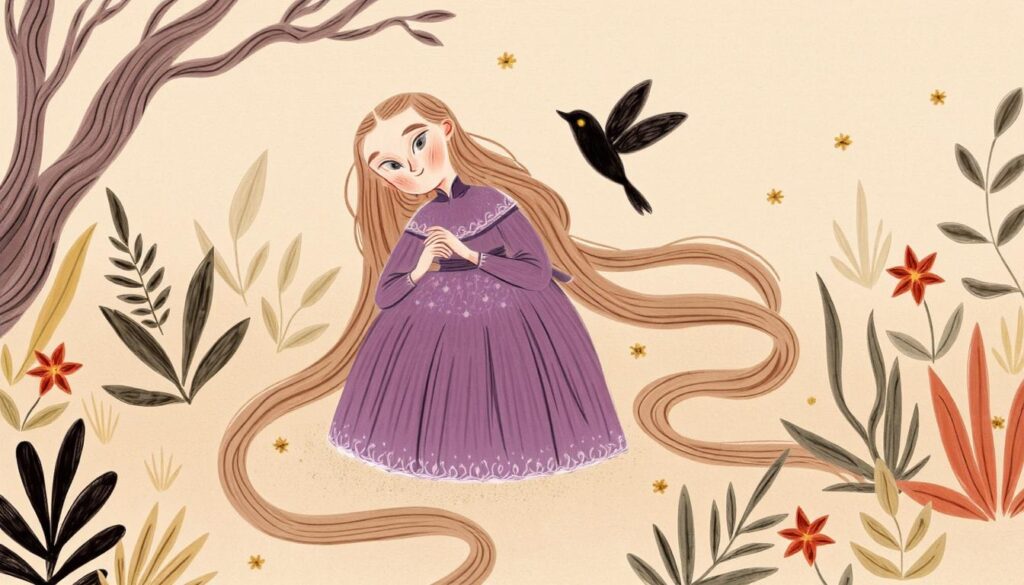
The Stolen Miracle — The Queen Who Wants to Stop Being One — She Who Is Choosing Her Successor to Be No One At All
“Most heirs spend their lives trying to keep a throne. Rapunzel has spent hers trying to give it away properly — and discovering that’s a harder problem than keeping it ever was.”
At a Glance
| Status | Living; rules Corona, actively preparing to abdicate into a democratic republic |
| Alignment | Neutral Good — idealistic, but seasoned by enough hard negotiation that the idealism has teeth |
| Domain | None divine. Mortal, descended from Corona’s royal line through Astor and Hilde, marked from before birth by a theft of borrowed magic |
| Symbols | A single flower with healing light caught inside it; an unbraided length of hair kept in a glass case; a tower window, deliberately left open |
| Divine Tier | Mortal — though her birth and her gift carried genuine magic for a time, drawn from an enchanted plant rather than from any bloodline of her own |
| Titles | Queen Rapunzel of Corona, the Lost Princess (old usage, rarely used to her face anymore), the Abdicating Queen (what the more skeptical nobles call her) |
| Known Kin | Husband: King Consort Eugene Fitzherbert, commoner by birth, fully supportive of her governance. Parents: the King and Queen who lost her as an infant and were eventually reunited with her. |
| Her contradiction | She was stolen because of a miracle worked on her behalf before she could consent to it. She has spent her adult life trying to make sure Corona’s future does not depend on anyone needing to ask her permission for anything at all. |
Part One — The Tower
A Theft Before She Could Speak
Rapunzel’s life began with a debt she never agreed to and could not have refused: her mother, pregnant and gravely ill, was healed by eating enchanted rapunzel plants from a witch’s garden — a theft her father, desperate, promised to repay with the child once she was born. The witch collected. Rapunzel spent most of her childhood and the whole of her adolescence in a tower with no door, raised by a woman who called herself mother and who valued her, when she valued her at all, for the magical properties of her unnaturally long, glowing hair rather than for anything resembling who she actually was.
She does not romanticize this period, regardless of how songs about lost princesses tend to romanticize towers. It was isolating in ways that took her years afterward to fully name, and the specific damage of having her worth measured entirely by what her body could provide to someone else has shaped nearly every value she holds as a ruler now.
Escape, and What Came After
She left the tower the way the old stories tell it — with help, with risk, and with a thief named Eugene who arrived for entirely selfish reasons and stayed for entirely different ones. What followed was a return to a kingdom that had never stopped grieving her, a joyful and disorienting reunion with parents who had spent her whole childhood searching, and a magic that thinned and eventually left her once the original theft’s purpose — keeping her alive and ageless inside the tower — no longer applied to a life lived outside it.
DM NOTE
The witch who held the original debt is dead, but the debt itself was sold long before her death to a buyer who has only recently surfaced — the Ledger-Keeper. This is established, ongoing campaign material: the original contract specified that the child would “serve the holder of this note in perpetuity,” and the folklore-literate resolution (the debt was voided when Rapunzel and her prince left the tower of their own free will, which the original story specifies ends the witch’s claim) is exactly the kind of legal argument the Ledger-Keeper is bound to respect if a party can document it properly.
Part Two — A Crown She Has Been Trying to Set Down
Why She Wants a Republic
Rapunzel’s politics did not come from theory. They came from eighteen years of having her entire life decided by someone else’s authority over her, and the conclusion she drew from it was not narrow — it was structural. She does not simply resent the witch who held her. She has come to distrust any system, including her own hereditary crown, where one person’s authority over many others rests on birth rather than consent. Ruling Corona well, to her, has meant treating the throne as something to be dismantled responsibly rather than occupied indefinitely.
She has been engineering Corona’s transition to a democratic republic for years now — building the council, training the administrators, doing the unglamorous structural work that actual political change requires rather than simply declaring it and walking away. She intends to abdicate once the transition is stable. She has been waiting, specifically, to see how the conflict with Germonia resolves before taking that final step, unwilling to hand a fragile new republic a war it isn’t ready to fight.
The Alliances She’s Weighing
Rapunzel watches Phillip’s ambitions toward Tirulia with real wariness — not because she dislikes Aurora, whom she genuinely respects, but because Phillip’s appetite for war is exactly the kind of unaccountable, single-person decision-making her whole political project is trying to move Grimm away from. She has been hoping for support from Tirulia and Arendelle, and Elsa’s evident caution about the wider conflict has made her a natural, if cautious, ally.
DM NOTE
Rapunzel’s political project gives a DM a clean throughline for any arc involving Grimm’s broader politics: she is the kingdom most actively trying to change the rules of the game everyone else is still playing by inheritance and conquest, and her caution about Phillip specifically is well-founded rather than personal. A party that helps stabilize Corona’s transition, or helps Rapunzel build the coalition she needs to abdicate safely, is doing some of the most structurally significant work available in the Grimm theater.
Part Three — Personality, Character, and How to Play Her
Alignment: Neutral Good
Rapunzel believes in people’s capacity to govern themselves and has built her entire reign around proving it, which makes her patient with process in a way that occasionally frustrates allies who want faster, more decisive action. She has learned, the hard way, that decisive unilateral authority is exactly the thing she’s trying to dismantle — even when wielding it herself would be easier.
| Trait | Expression in Play |
|---|---|
| Allergic to unaccountable power, including her own | She second-guesses her own authority more than most rulers second-guess anyone’s. A party that brings her a problem with an easy authoritarian solution will find her looking for the harder, more durable answer instead. |
| Warmer than her politics might suggest | Rapunzel is not cold or theoretical about any of this. She is fiercely, openly affectionate with the people she trusts, and her years of isolation have made her unusually direct about saying so. |
| Carries real, unresolved grief about the tower | She does not perform victimhood, but she has not fully made peace with what was taken from her either. References to her old captor, even oblique ones, land harder than her composed exterior suggests. |
| Stubborn about the timeline, not the goal | She will not be rushed into abdicating before the republic is ready, no matter how much pressure builds. This is not indecision — it is the same caution that kept her alive in the tower, repurposed toward a goal she actually chose. |
| Trusts Eugene completely, and says so | Unlike many political marriages in Grimm, hers is a genuine partnership, and she treats his counsel — particularly on questions of what ordinary people actually need — as seriously as any advisor’s. |
Rapunzel in the Campaign
Rapunzel is one of the most proactive rulers in Grimm for a party interested in political solutions rather than purely military ones — she has spent years building the infrastructure for exactly the kind of cross-kingdom cooperation the wider conflict demands, and she will recognize and reward a party that brings her genuine help rather than simple flattery.
Her unresolved tower debt, now in the Ledger-Keeper’s hands, is a live and personal thread: the demand that she abandon Corona’s democratic transition entirely and rule as an absolute monarch under terms that would make her a vassal is precisely the outcome her entire adult life has been organized against. A party that helps her win that arbitration is not just resolving a contract dispute. They are helping her finish becoming the person she decided to be the moment she walked out of the tower.
Leave a Reply