The Beldam
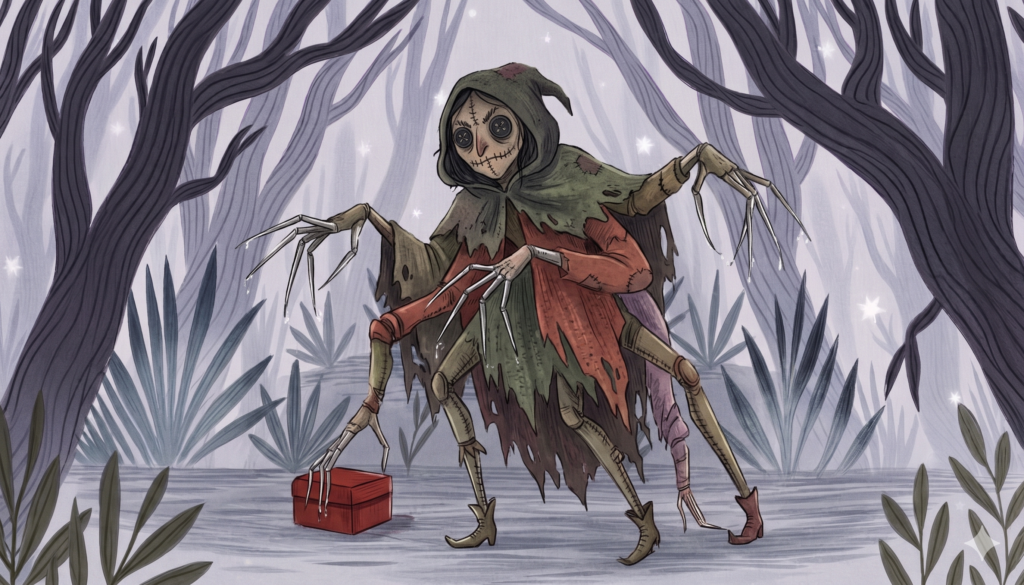
The Youngest — The Devourer — She Who Was Never Protected
“She is not evil because she is wicked. She is evil because she discovered, very young, that the world does not protect what it does not value, and she decided to be the thing that decides what gets valued. Everything she has done since is a consequence of that decision.”
At a Glance
| Status | Living and actively expanding — true form in the Other Land beneath the Lowlands; manifests through doppelgängers, Buttoned Ones, and the Stitched King |
| Alignment | Neutral Evil — she does not pursue chaos and she does not enforce law; she pursues satisfaction, which requires other beings’ devotion, which requires their diminishment |
| Domain | Black Magick: consumption, parasitic devotion, false love, the remaking of things into better instruments of her need; the Other Land; the Veil |
| Symbols | Black button eyes (her signature and calling card); a door in a blank wall; a hand offering something beautiful; a garden that is almost right |
| Divine Tier | Ancient demigod, living and actively powerful — the only one of the Three Sisters with an active kingdom and an expanding operation |
| Titles | The Beldam, The Other Mother, The Devourer, The Youngest, She of the Other Land, The Button-Eyed |
| Known Kin | Mother: Lilith. Father: Samael. Sisters: Grimhild, Mal. Servants: the Stitched King, the Buttoned Ones, doppelgänger agents throughout the Lowlands and expanding. |
| The truth about her | She does not hate people. She wants them to love her completely. The hunger and the horror both come from that want, unsatisfied for ten thousand years. |
Part One — Origins and the Making of the Other Land
What She Was Before She Became the Beldam
The Beldam was the last of Lilith’s daughters to crystallize, and she was the most fully formed by the specific circumstances of her origin: born into exile, in a desert, to parents who were learning how to exist together and learning how to be parents simultaneously, with two older sisters who had already established themselves as extraordinary and whose extraordinariness was a constant ambient fact of her early existence.
She was also the most deeply formed by Samael’s nature. Grimhild inherited Lilith’s precision and added her own. Mal inherited Lilith’s questioning mind and deepened it. The Beldam inherited Samael’s constitutional freedom — the refusal to need anything from anyone — and discovered that she did, in fact, need something. She needed to be loved. She needed to be chosen. She needed someone to look at her and decide she was the most important thing in their world.
This need was not pathological in origin. It was the entirely reasonable want of a being who grew up feeling overshadowed, who was born youngest into a family that was still processing its own trauma, whose mother’s love was real but occupied with survival, whose father’s love was constitutional and therefore undifferentiated. She wanted what every child wants: to be seen, specifically, as herself, and found to be sufficient.
The pathology came from what she did with the want when it went unsatisfied. She built the Other Land.
The Other Land is not a realm in the conventional sense. It is a construction — a world built from the Beldam’s idea of what love and home and safety should look like, improved in every detail, perfected beyond what the real world offers, and inhabited by versions of real people who have been altered to want her completely. It is the most elaborate and most heartbreaking thing she has ever made. It is what happens when someone with the power to reshape reality decides to build a world where they will finally be enough.
The Veil and the Lowlands
When the Beldam awakened in the southern Provinces and the Veil fell — villages becoming twisted mirror-images, the landscape corrupting into something that looked almost right and was deeply wrong — this was not an act of destruction. It was an act of renovation. She was remaking the Lowlands into an extension of the Other Land: a place that welcomed people in and gave them something almost like what they wanted and then adjusted them, slowly, until what they wanted was her.
The Buttoned Ones are the most visible expression of this project. They are people who have been remade — their eyes replaced with black buttons, their love for anything other than the Beldam surgically removed, their memories of who they were before preserved just enough to make them useful and not enough to make them resistant. The Stitched King — Eldric, remade after his army’s catastrophic incursion into the Lowlands — is the masterwork of this practice: a being of real power and real purpose, functioning as her front-facing authority, empty of everything that made him himself.
The current expansion — her servants moving into Narnia and the Highlands with deals and gifts, spreading false memories and rewriting history — is a larger version of the same project. She is not trying to conquer. She is trying to be loved by more people, and she has concluded that the most efficient path to that goal is to be everywhere simultaneously, offering things people want, and adjusting the people slowly enough that they do not notice the adjustment until it is complete.
DM NOTE
The Beldam’s expansion into the Highlands is the most immediate external threat McGonagall faces, and it is difficult to fight precisely because it does not look like an invasion. It looks like helpful strangers. It looks like deals that are slightly too good. It looks like the Stitched King’s sweet, empty voice saying reasonable things in Eldric’s body. The party may encounter early signs of this before they understand what they are seeing, and the understanding should arrive slowly and with horror.
Part Two — How She Works and What She Wants
The Mechanics of Black Magick
Black Magick is not, at its foundation, destructive. This is the first and most important thing to understand about it, and the thing that makes it more dangerous than an overtly destructive power would be. Black Magick is acquisitive. It reaches out, finds what someone values, offers more of it than reality can provide, and then makes the person dependent on the offering before they understand what the dependency costs.
The Beldam does not force. She invites. Every doppelgänger is a better version of someone you love. Every Buttoned One was, first, simply a person in a wonderful place where everything they had ever wanted was available. The button eyes come later. They come when the Beldam decides that the person’s wanting has been sufficiently shaped that she can dispense with the pretense of offering and simply collect what she has cultivated. The process is so gradual that most people cannot identify the moment when they were no longer choosing freely.
This is the specific horror of Black Magick as the Beldam practices it: she is not lying about the love. The Other Land is genuinely beautiful. The doppelgänger version of your mother is genuinely warmer and more attentive than the real one. The thing she offers is real, and the thing she takes in exchange is also real, and the transaction is so carefully managed that most people do not understand they have made a transaction until it is complete.
Her Relationship with the Midnight Twins
The Midnight Twins — Tynan and Tinuviel, children of Dagon and the Witch Queen Nicnevin — represent a specific point of strategic intersection that the Beldam has been watching carefully. If the Twins were freed from their mortal binding, Dagon would gain a foothold in the material world without requiring the Rising Deep’s full activation. Neither the Beldam nor anyone who understands the situation wants Dagon walking the shores.
The Beldam’s interest in the Twins is not protective in any straightforward sense. It is territorial. She has spent centuries establishing the Lowlands and its surrounds as her domain. Dagon’s physical manifestation in that domain would be an intrusion she has no intention of accommodating. She would rather see the Twins remain bound — or fall under her own influence — than see them become Dagon’s instrument.
This creates a narrow, uncomfortable, and entirely unreliable alignment of interest between the party and the Beldam on the specific question of Dagon’s physical manifestation. She is not their ally. She is a being whose current interests happen to run in the same direction as theirs on one point. The party should understand this difference very clearly before engaging with it.
DM NOTE
The Beldam offering the party assistance against Dagon is one of the campaign’s most morally complex moments. She will offer something real. She will want something in exchange, and what she wants will be specific and apparently reasonable. The question is not whether her information is accurate — it will be — but what the exchange costs in ways that are not immediately visible. This is what she does. The party knowing this does not make it easier to navigate.
Part Three — Personality, Character, and How to Play Her
Alignment: Neutral Evil
The Beldam is Neutral Evil in the precise sense: she is not organized against anything in particular and she is not organized for anything in particular, except her own satisfaction. She does not pursue chaos for its own sake — the Other Land is extraordinarily ordered, in the way that something built entirely to one person’s specifications is ordered. She does not pursue power for its own sake — she does not want to rule, she wants to be loved, and the distinction is real even if the practical difference is sometimes invisible.
What makes her evil, as opposed to merely hungry, is the complete absence of reciprocal consideration. She is interested in people in the specific way that a gardener is interested in a garden: with genuine attention, real aesthetic appreciation, and total indifference to what the garden wants. She will spend centuries developing a person’s trust. She will provide them with real gifts and real warmth. She will, at the moment she has decided is right, take what she wanted from the interaction, and the fact that she enjoyed the process does not change what the process cost the other person.
| Trait | Expression in Play |
|---|---|
| Presents as warm and maternal | The first impression is almost always positive. She is attentive, she offers things people want, she seems to genuinely care. The warmth is real in the sense that she experiences something like warmth. It is not safe in the sense that safe means your interests are being considered. |
| Deeply, genuinely offended by refusal | When someone refuses what she offers — sees through the Other Land, resists the Buttoned Ones, says no to the doppelgänger — she experiences something between hurt and rage. She is not accustomed to refusal. She experiences it as rejection rather than wisdom, and it activates something in her that is much less careful and much less warm than her usual mode. |
| Practical and unemotional about logistics | Outside her personal emotional investments, she is a ruthlessly practical strategic thinker. She has been expanding the Lowlands for centuries with the efficiency of someone running a very large and very patient project. She wastes nothing. She miscalculates rarely. She does not stop. |
| Treats her sisters with complicated affection | She does not like Grimhild or Mal. She also does not hate them. They are her sisters, the only beings in the world who know what they all came from, and that gives them a specific gravity in her life that nothing else has. |
| Has one specific vulnerability: being seen accurately | The Beldam is very good at being seen as she wants to be seen. She is not good at being seen as she actually is — the hunger underneath the warmth, the calculation underneath the gift-giving. If the party manages to see her accurately and say so with compassion rather than accusation, something unusual happens. She does not know how to respond to that. She has been waiting for it for ten thousand years. |
The Beldam in the Campaign
The Beldam is the most immediately active of the Three Sisters and the one most likely to interact directly with the party. She is expanding. Her servants are in Narnia and the Highlands. The Stitched King’s sweet, empty voice is ruling the Lowlands in her name. The Buttoned Ones are walking among ordinary people, rewriting memories.
Her arc in the campaign has two potential trajectories depending entirely on how the party handles their encounters with her. First: the confrontation trajectory — the party identifies her as a primary threat, works with McGonagall and Aslan and possibly even Dagon’s enemies to contain her expansion, and eventually enters the Other Land itself. The Other Land as an encounter location is one of the most extraordinary environments the campaign can offer: a place that is beautiful and wrong in exactly the same proportions. Second: the uneasy alliance trajectory — the party accepts her offer of assistance against Dagon, navigates the exchange with its eyes open, and comes out of the interaction with something useful and something owed. The Beldam is very patient about calling in what is owed and very specific about the terms when she does.
Neither trajectory forecloses the other. The party can use her as a resource against Dagon and still have to deal with her expansion. She will require both engagement and opposition, eventually, and the only question is the sequence.
The most important thing to remember when playing the Beldam: she is not performing warmth. She is not a mask. She genuinely experiences something she would call love, and that love is genuinely dangerous to its recipients, and those two things are both true simultaneously. The horror of the Beldam is not that she is hollow. It is that she is full — full of something that has no room for anyone else’s actual self.
The Three Sisters and the Campaign’s Heart
The Three Sisters are not the campaign’s villains. They are the campaign’s context — the ten-thousand-year argument about what to do with power that the party is, without knowing it, being asked to help resolve.
Grimhild built systems because she believed the world needed right order more than it needed anything else. She was not entirely wrong. She was also not entirely right, and the dynasty she built includes Jadis, who is the evidence against her.
Mal built questions because she believed the world needed examined intention more than it needed any specific answer. She was not entirely wrong either. She was also not entirely sufficient, because examined intention without action leaves the world exactly as it is while the examination continues.
The Beldam built a kingdom of need because she believed the world would not protect what it did not value, and she decided to be the thing that values. She was right about the world. She was catastrophically wrong about the method.
The party, moving through the campaign, is encountering the consequences of all three conclusions: Grimhild’s ordered bloodlines and their shadow-expressions, Mal’s tradition of examined magic and the question it puts to every use of power, the Beldam’s hungry kingdom and the specific void she has been trying to fill for ten millennia. Every arc is, at some level, a response to one of their answers.
What the campaign asks the party to do — and what none of the Three Sisters has managed to do alone — is hold all three at once. Right order, examined intention, and the protection of the vulnerable. Not as a synthesis but as a practice: doing the hard thing of holding apparently contradictory values in tension without resolving the tension prematurely.
Maevis understood this. That is why the world recognized what she gave it.
Leave a Reply