The Three Sisters: Grimhild, Mal, and the Beldam
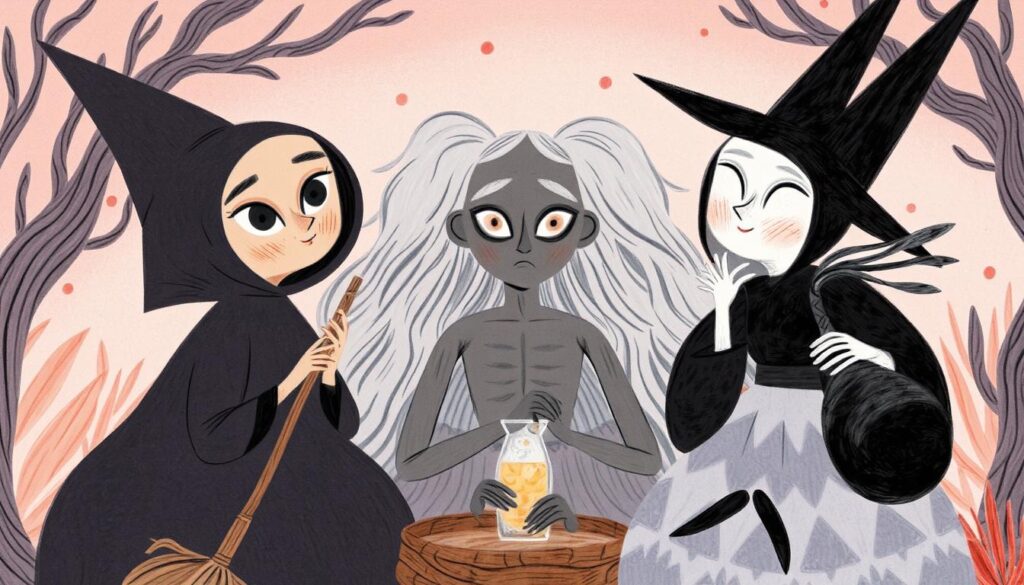
“She raised them in the dark and the desert and the wild places the One God’s influence had not yet reached. She taught them that power was real and should be used, that choice was the most sacred thing in the world, and that submission to an unjust authority was the one thing she would never ask of them. They each heard a different lesson.”
What They Are
The Three Sisters are the daughters of Lilith and Samael — born across centuries in the Impassible Desert and the wild margins of Once, each one a different resolution of the same inheritance. From Lilith they received the living magic of Danu’s bloodline: deep, transformative, ungovernable by the One God’s law. From Samael they received the devil’s constitutional freedom: the fundamental refusal to be ranked, to be ordered, to owe anything to any authority they did not choose.
What each did with those two inheritances is the story of the Three Sisters — and, in many ways, the story of magic in Once. Grimhild wanted order that was truly just. Mal wanted freedom that was truly moral. The Beldam wanted to never be hungry again.
How They Relate to Each Other
The Sisters are aware of each other. They are not allies. They are not enemies. They are siblings who have had the same argument since before mortal memory began. The argument is about their mother.
Grimhild believes Lilith’s defiance was necessary but that it cannot be the end of the story — that the world needs structure, needs order, needs things put right. Mal believes Lilith’s lesson was the only lesson: that intention is everything. The Beldam believes both of them have missed the point entirely: nobody protected Lilith, and in a world where nobody protects you, you learn to feed yourself.
DM NOTE
DM Note: The Three Sisters share one thing that none of them ever says out loud: they each love their mother, and each of them is, in a way she would not fully acknowledge, trying to do something their mother would recognize as right. Grimhild is trying to build the world Danu offered the One God. Mal is trying to live by the values Lilith died for. The Beldam is trying to never be the one who needs protection again.
| Grimhild | Eldest — White Magick — Danu → Lilith & Samael → Grimhild → Lurline → Glinda, Elphaba, Jadis |
| Mal | Middle — Gray Magick — Danu → Lilith & Samael → Mal → Highland witch bloodline → McGonagall |
| The Beldam | Youngest — Black Magick — living, active, expanding — Danu → Lilith & Samael → The Beldam → Lowlands → Buttoned Ones |
Grimhild
The Eldest — The Perfecter — She Who Would Make Things Right
| Alignment | Lawful Good, with a rigidity that tips toward Lawful Neutral when frightened |
| Domain | White Magick: purification, healing, restoration of right order |
| Known Kin | Mother: Lilith. Father: Samael. Sisters: Mal, the Beldam. Bloodline: Lurline → Glinda → Elphaba → Jadis |
Origins and the Shaping of White Magick
Grimhild was the first of Lilith’s daughters. She inherited her mother’s precision and her father’s constitutional refusal to be less than she was, and added a quality entirely her own: the need to understand why things worked, and to make them work better. White Magick — the tradition she founded — is her most significant act: a disciplined, teachable system for working with living magic in ways that heal and restore, rather than consume or command.
Lurline’s enchantment of Oz, Glinda’s inheritance, and Jadis’s dark inversion are all chapters in the long story of what happens when a magical tradition passes through enough hands to encounter the full range of mortal character. Jadis carries the full technical inheritance of White Magick and has systematically inverted every principle it holds. She is not a corruption of Grimhild’s legacy — she is a genuine daughter of it.
DM NOTE
DM Note: Grimhild’s relationship with Jadis is the deepest unresolved question of her existence. She will not answer direct questions about it. Everything else she can discuss with the measured authority of ten thousand years of thought. This one she has not finished thinking about.
Personality and How to Play Her
Grimhild is Lawful Good because she built order herself, from principles tested and revised — not because law was given to her. She has never entirely resolved the tension between “things should be structured” and “things should be just.”
| Precise and thorough | She does not give partial answers. An excellent teacher, occasionally exhausting conversationalist. |
| Genuinely invested in repair | When something is broken, her attention fixes on it with real warmth. Her best quality. |
| Difficult relationship with being wrong | She will maintain a position past the point most would concede, then concede — clearly having thought hard about it. |
| Complicated maternal feeling toward her bloodline | She follows Glinda’s and Jadis’s choices with the attention of someone who cannot stop caring even when it produces only pain. |
Grimhild is the ancestral authority behind every White Magick practitioner the party encounters. If the party reaches the Oz arc, she may manifest — not as a person, but as a quality in the magic itself. The party’s clearest encounter with her legacy is Jadis — which is not comforting, but is accurate.
Mal
The Middle Sister — The Intentionalist — She Who Asks Why Before How
| Alignment | True Neutral — “Intent determines alignment, not category.” |
| Domain | Gray Magick: moral intentionality in spellcraft, the ethics of power |
| Known Kin | Mother: Lilith. Father: Samael. Sisters: Grimhild, the Beldam. Descendants: the Highlands’ sorcerer-kings; McGonagall |
Origins and the Making of Gray Magick
Mal was born between Grimhild’s perfecting impulse and the Beldam’s hunger, and grew up asking: why? What is the purpose of the correcting? Of the consuming? Gray Magick is the system she built from this discovery — not “what does the magic do” but “what is the magic for, and is that reason good enough.” The technique comes after; it is almost secondary.
Mal taught mortals directly, person to person, over centuries — the Highlands’ sorcerer-kings and, eventually, McGonagall, whose mixed mortal-witch lineage embodies exactly the tension Mal finds most interesting.
DM NOTE
DM Note: If pressed about the deeper history of Highland magic, McGonagall will acknowledge “the tradition before the tradition.” She knows who taught the first ones. She has not decided if the party is ready to know.
Personality and How to Play Her
Mal cares about outcomes and people, but will not act on the side of good simply because it feels right — she acts when she has examined a situation and concluded a specific act is warranted.
| Trait | Expression in Play |
|---|---|
| Questions everything, including herself | She will actually consider a challenge to her position rather than defend it reflexively. |
| Extraordinarily patient | She has waited ten thousand years for mortals to ask the right questions about magic. |
| Quietly protective of Lilith’s memory | She corrects mischaracterizations of her mother with information, not argument. |
Mal is the least directly present Sister, most likely to appear as a genuine encounter. Her relationship with the Ledger-Keeper — an old unresolved argument about intent and contracts — is worth noting.
The Beldam
The Youngest — The Devourer — She Who Was Never Protected
| Alignment | Neutral Evil — she pursues satisfaction, which requires others’ devotion and diminishment |
| Domain | Black Magick: consumption, parasitic devotion, false love; the Other Land; the Veil |
| Known Kin | Mother: Lilith. Father: Samael. Sisters: Grimhild, Mal. Servants: the Stitched King, the Buttoned Ones |
| The Truth About Her | She does not hate people. She wants them to love her completely — unsatisfied for ten thousand years. |
Origins and the Making of the Other Land
The Beldam was the last daughter to crystallize, the most deeply formed by Samael’s nature — and discovered she needed something her father’s freedom never accounted for: to be loved, to be chosen. The pathology came from what she did with that want when it went unsatisfied. She built the Other Land: a construction, perfected beyond what reality offers, inhabited by versions of real people altered to want her completely.
The Buttoned Ones are her most visible project — people remade, their love for anything but her surgically removed. The Stitched King is her masterwork. Her current expansion into Narnia and the Highlands is the same project at larger scale: she is not trying to conquer, she is trying to be loved by more people.
DM NOTE
DM Note: The Beldam’s expansion is difficult to fight because it does not look like an invasion. It looks like helpful strangers and deals that are slightly too good. Understanding should arrive slowly, with horror.
How She Works and What She Wants
Black Magick is acquisitive, not destructive — it offers more of what someone values than reality can provide, then makes them dependent before they understand the cost. The Beldam does not lie about the love. The Other Land is genuinely beautiful. The thing she takes in exchange is also real.
Her interest in the Midnight Twins (children of Dagon) is territorial, not protective — she’d rather they stay bound than become Dagon’s instrument, creating an unreliable point of aligned interest with the party.
DM NOTE
DM Note: The Beldam offering assistance against Dagon is one of the campaign’s most morally complex moments. Her information will be accurate. What the exchange costs is not immediately visible.
Personality and How to Play Her
| Trait | Expression in Play |
|---|---|
| Presents as warm and maternal | The warmth is real in the sense she experiences it. Not safe in the sense your interests are considered. |
| Deeply offended by refusal | She experiences refusal as rejection rather than wisdom — it activates something far less warm. |
| Has one specific vulnerability: being seen accurately | If the party sees her accurately and says so with compassion rather than accusation, something unusual happens. She has waited ten thousand years for it. |
The most important thing to remember when playing the Beldam: she is not performing warmth. She genuinely experiences something she would call love, and that love is genuinely dangerous to its recipients. The horror of the Beldam is not that she is hollow — it is that she is full, full of something with no room for anyone else’s actual self.
The Three Sisters and the Campaign’s Heart
The Three Sisters are not the campaign’s villains. They are its context — the ten-thousand-year argument about what to do with power that the party is, without knowing it, being asked to help resolve.
Grimhild built systems because the world needed right order — and the dynasty she built includes Jadis, the evidence against her. Mal built questions because the world needed examined intention — but examined intention without action leaves the world exactly as it is. The Beldam built a kingdom of need because the world would not protect what it did not value — she was right about the world and catastrophically wrong about the method.
Leave a Reply